Visible debris in floor registers
Lift a floor grille and look down. Pet hair, toys, pebbles or a thick gray layer in the boot mean it is time for cleaning.
Registers coated in gray fuzz, drywall dust left behind after a remodel, or debris you can see when you lift a floor grille are good reasons to have the duct system cleaned properly.
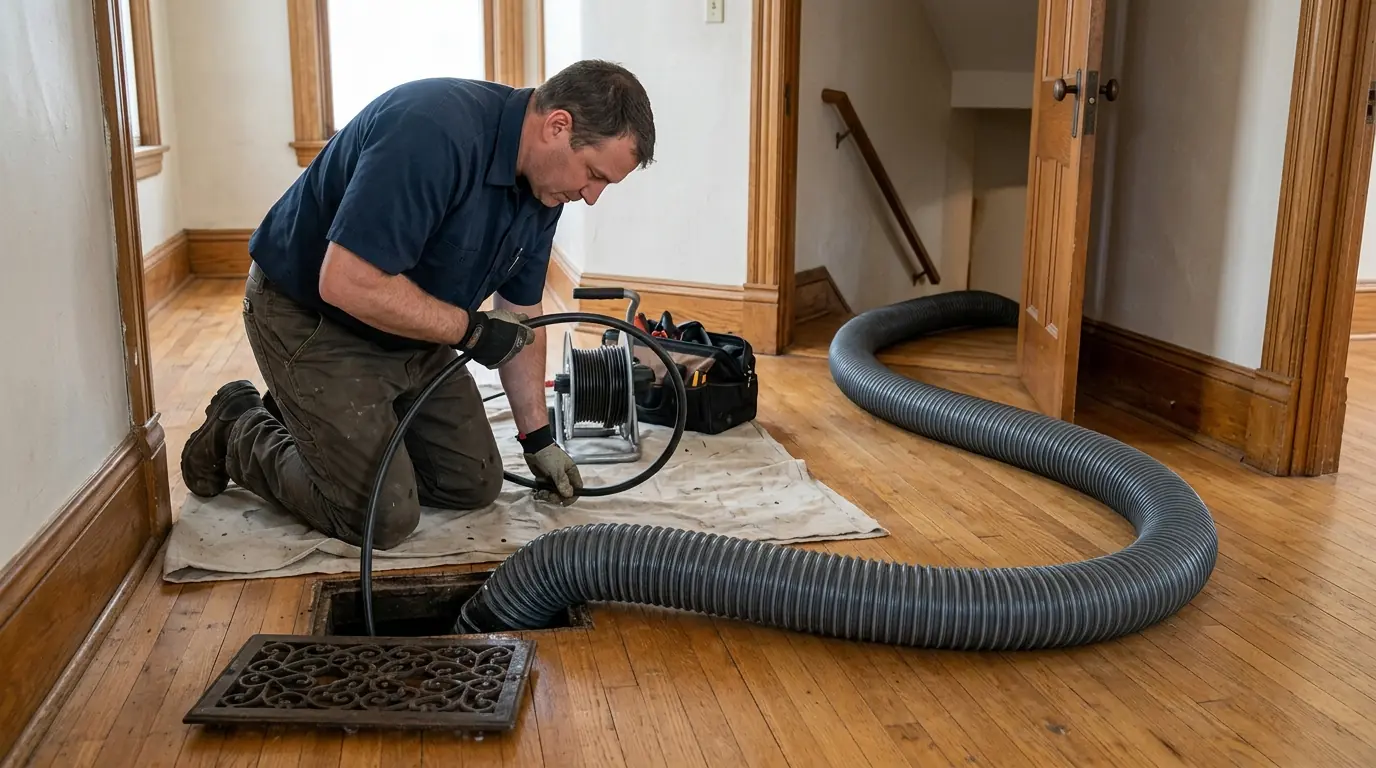
Professional duct cleaning connects a high-powered vacuum to the main supply and return trunks to hold the system under negative pressure. Technicians then run rotary brushes and compressed air tools through each branch to loosen debris, which is drawn into the collector. A typical single-system home takes three to five hours, including the registers, grilles and blower compartment.
Ductwork collects material slowly. Every time the blower starts, a small amount of dust, hair, construction debris and lint that slipped past the filter settles in the return trunks and the bottoms of floor boots. In most homes that layer stays put and causes little trouble, but after a remodel, a move into a house that sat empty, or years of a loose filter, it can build up enough to matter.
Our technicians clean ducts with a truck-mounted or portable negative-pressure collector connected to the main trunk, while rotary brushes and air whips work through each branch line. Loosened debris is pulled back toward the collector instead of blowing into your rooms. We also look at the blower wheel and coil, since a clean duct system feeding a dirty blower does not get you very far.
Lift a floor grille and look down. Pet hair, toys, pebbles or a thick gray layer in the boot mean it is time for cleaning.
Sanding dust travels into open returns and coats the ductwork, often well beyond the room that was worked on.
You have no idea how the ducts were cared for, and years of buildup may be sitting in the return trunk.
A small cloud from supply registers at startup shows loose material is sitting in the duct runs.
Droppings, nesting material or a dead animal smell from a vent need cleaning and a look at how they got in.
Caked fins on the blower wheel point to dirt moving through the whole system, not just the filter.
A real cleaning starts at the source of airflow and works out to every opening. We cut a sealed access port into the main return and supply trunks, connect the collector and bring the system under strong negative pressure. Every supply and return register is removed, washed and set aside while each branch is cleaned with brushes or air tools sized to the duct.
The blower compartment is vacuumed, and if the blower wheel is coated we discuss removing and cleaning it. The access ports are sealed with metal patches and foil tape when we finish. Quick visits that only vacuum the registers do not reach the material sitting deep in the trunks, and they are not what we provide. You can see the before and after through the registers yourself.
Homes built in the 1950s and 1960s in neighborhoods like Burke Acres and Milwood often have panned floor joist returns, where the space between two joists is closed off with sheet metal and used as a return duct. Those cavities collect dust and debris along the wood and are a common source of air leaks. We clean them as far as access allows and point out any open seams worth sealing.
Early 1900s homes that were converted from gravity heat to forced air sometimes have a mix of round pipe, old stack ducts in the walls and newer branch lines. Floor registers in those homes catch a surprising amount of debris over the decades. In these older houses, cleaning is often paired with duct sealing to close the gaps that let basement dust in.

Cleaning removes built-up debris from the ductwork and blower and can cut down on dust puffs and odors that come from inside the system. It is especially worthwhile after construction dust, pest activity or when you can see heavy buildup. It is not a medical treatment or a replacement for good filtration, and the house will gather dust again if air keeps bypassing the filter.
That is why our technician also checks the filter slot fit and looks for open return seams that pull air from unfinished basements, attics or crawlspaces. If those leaks stay open, new dirt starts collecting right away. Fixing them, and upgrading to a media filter cabinet where it makes sense, keeps the ducts cleaner for much longer after the visit.
There is no fixed schedule that fits every house. A home with a good, well-sealed filter, no pets and no recent construction may go many years without needing a cleaning. A household with several dogs, a wood stove or a recent basement finish might benefit every few years. We look at the ducts before recommending cleaning, and if they do not need it, we say so.
Spring and fall are popular times, because the furnace and air conditioner are changing roles and the system will run hard for months afterward. Coordinating a duct cleaning with a seasonal tune-up lets the technician clean the coil and blower on the same trip, so everything starts the heavy season clean at once. That keeps the visit count down for you as well.
| Work | Typical range |
|---|---|
| Whole-home duct cleaning, single system | $389 to $684 |
| Second furnace or air handler system | $247 to $438 |
| Blower wheel removal and cleaning | $148 to $296 |
| Evaporator coil cleaning | $186 to $412 |
| Return seam sealing during cleaning | $134 to $367 |
Ranges are typical for Southwest Michigan homes. The final price is set after the technician sees the duct layout, number of registers and system condition. Compare more jobs in the furnace and AC price guide.
Keep reading
Mastic leak sealing, repaired joints, reinsulated attic runs and fixed disconnects so the air you pay to heat reaches your rooms.
Learn moreMedia filter cabinets, in-duct air cleaners and coil UV lamps fitted to your furnace so cleaner air moves through every room.
Learn moreLint removal from the dryer duct to the outside hood, with airflow checks and fixes for crushed, long or poorly routed vent runs.
Learn moreFAQ
It should not. The collector keeps the ductwork under negative pressure, so loosened material moves toward the machine instead of into your rooms. We cover floors near the work area and the furnace. You may see a small amount of dust at a register while it is being cleaned, which we wipe up before moving on.
Flex duct can be cleaned gently with soft brushes or air tools, but aggressive brushing can tear the inner liner. If a flex run is crushed, torn or badly dirty, replacing that section often makes more sense. We check the condition before cleaning and tell you which runs are worth keeping.
We do not routinely spray coatings or fragrances inside ductwork. Mechanical cleaning removes the debris, and the best way to keep the system clean is a well-fitted filter and sealed joints. If there is specific contamination, such as from rodents, we discuss the right approach for that situation.
Look into a floor register with a flashlight. A thin film of dust is normal, but clumps, pet hair, debris or visible construction dust suggest cleaning is worthwhile. Our technician can also take photos inside the trunk. If the ducts look reasonably clean, we will tell you the money is better spent elsewhere.
Yes. Some loosened particles inevitably reach the filter during the process, so we install a fresh one before leaving. It is also a good time to look at the filter slot, since a loose filter is often the reason the ducts got dirty in the first place.
Call any hour. Our office answers, sets the visit and tells you what to expect before a technician arrives.