Lockout code on the unit
High pressure, low pressure and loss-of-charge lockouts each point to a different fault, from poor water flow to a dirty air filter.
Your geothermal system is throwing a lockout code, running long without warming the house, or the loop pressure gauge has crept down and you are not sure what that means.
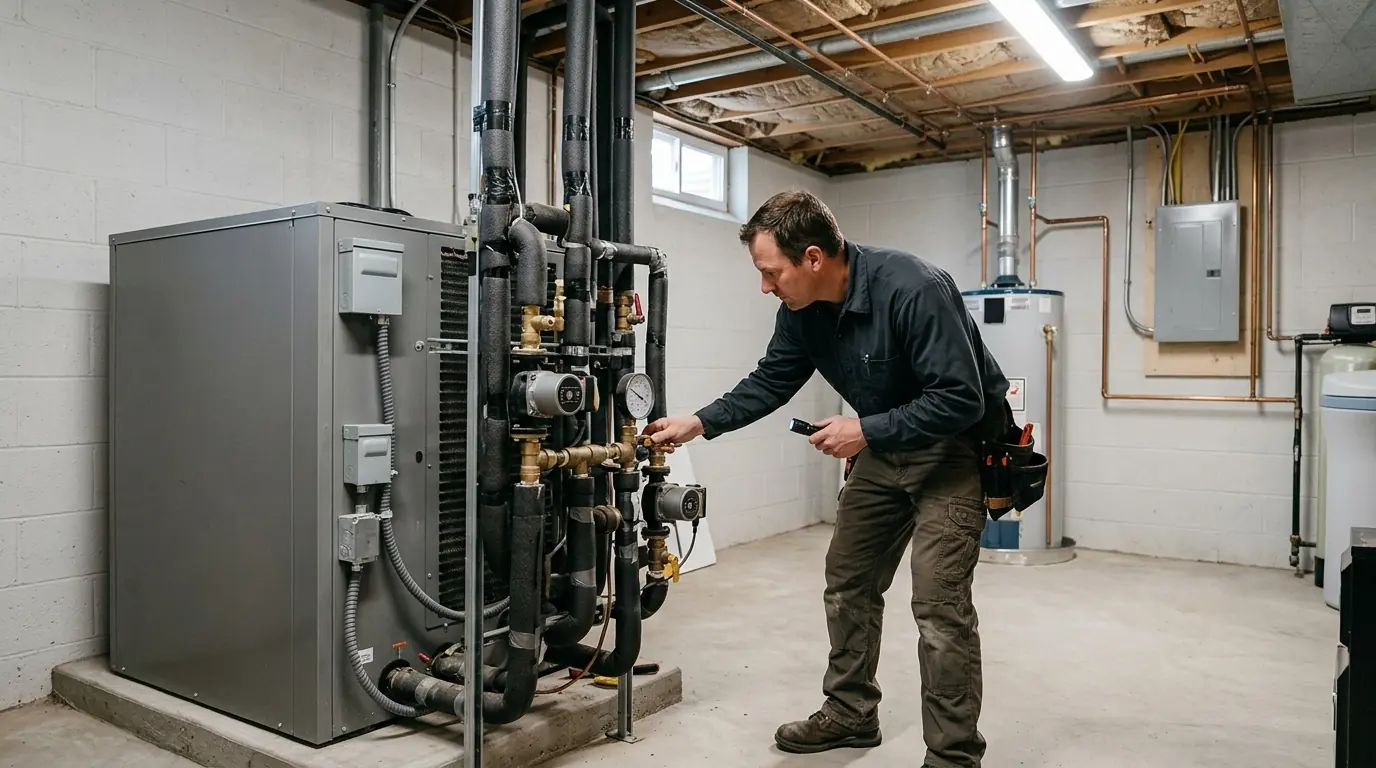
Most geothermal service calls involve low loop pressure, a failed circulating pump in the flow center, a high or low pressure lockout, or a weak compressor. A technician compares water temperature change across the unit with refrigerant readings to find the cause. Typical repairs in Southwest Michigan run $247 to $2,890, with loop excavation repairs priced separately.
A geothermal heat pump trades heat with the ground through a loop of buried pipe, so it sees steady temperatures even when the air outside is below zero. That stability makes these systems efficient and long lived, but it also means problems often hide in places a standard HVAC visit never looks, such as loop flow, fluid pressure and the water-to-refrigerant heat exchanger.
Our technicians service closed-loop and open-loop geothermal systems found in rural and suburban homes around Kalamazoo. We read the unit's fault history, measure entering and leaving water temperatures, and check the flow center and loop pressure before touching the refrigerant side. You get a clear answer and a price first. The line at (269) 360-5258 is answered day and night, every day.
High pressure, low pressure and loss-of-charge lockouts each point to a different fault, from poor water flow to a dirty air filter.
A slow drop on a pressurized closed loop suggests a leak at a fitting, a flow center seal or, less often, in the buried pipe.
When the electric backup carries the load in mild weather, the compressor or loop is not delivering the heat it should.
Air trapped in the loop or a worn circulating pump makes noise and cuts flow, which leads to low pressure trips in winter.
Units with a desuperheater preheat domestic water. A failed desuperheater pump or a scaled heat exchanger stops that boost.
Iron and mineral buildup common in Michigan well water can scale the heat exchanger and restrict flow on open-loop systems.
We begin with the unit's controller, since most modern geothermal units log faults with a time stamp. That history often shows whether a lockout happens on cold mornings, on long cooling runs or only after the auxiliary heat kicks in. Next we check the air side: filter, blower motor and the condition of the indoor coil, because poor airflow causes as many lockouts as loop problems do.
On the water side, we read loop pressure, measure the temperature of fluid entering and leaving the unit, and check the pressure drop across the heat exchanger. Those numbers show whether the loop is moving enough fluid. Only then do we connect gauges to the refrigerant circuit, so we are diagnosing the whole system instead of guessing at the compressor.
Most residential geothermal systems in this area use a closed loop filled with water and antifreeze, buried in horizontal trenches or vertical bores. The flow center, usually mounted beside the unit, holds one or two circulating pumps that push fluid through the loop. A worn pump bearing or a failed capacitor lets flow drop, and in winter that causes freeze protection or low pressure trips.
Antifreeze strength also matters in a Michigan climate. Fluid that has been diluted by topping off with plain water can thicken or freeze inside the heat exchanger during a January cold spell. We test concentration with a refractometer and correct it if needed. If air is trapped in the loop, we purge it with a flush cart so the pumps can move fluid quietly again.
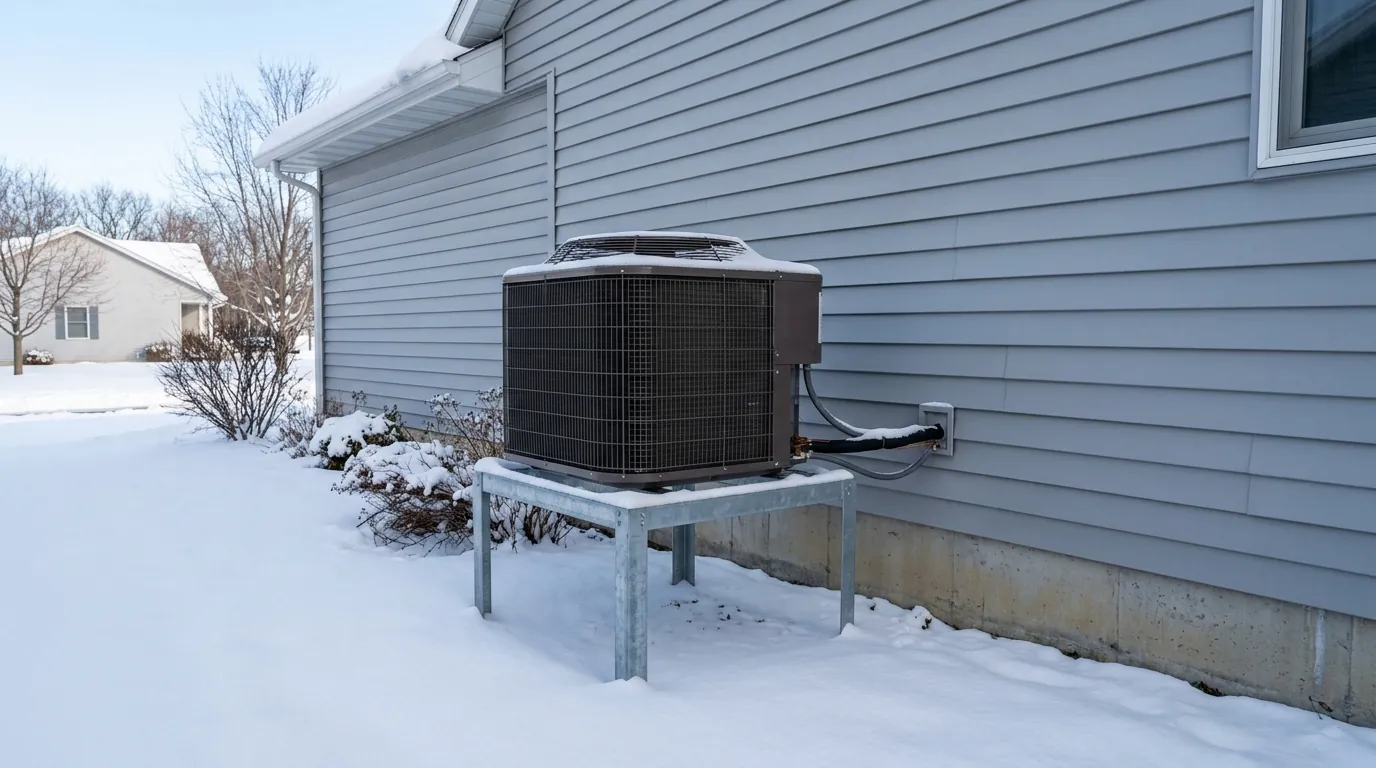
Inside the cabinet, a geothermal unit has the same core parts as an air-source heat pump: compressor, reversing valve, expansion valve and indoor coil, plus a coaxial water-to-refrigerant heat exchanger. Because the system runs so many hours in a typical year, compressor contactors and capacitors wear out on schedule, and a reversing valve can stick after years of heavy, year-round service.
Leaks in the refrigerant circuit are less common than in outdoor units because nothing is exposed to weather, but brazed joints can still crack from vibration. When a compressor fails on a unit past 18 to 20 years, we price a compressor replacement and a new indoor unit side by side. The buried loop usually outlasts several indoor units, so replacing the unit often makes sense.
Some rural homes run open-loop geothermal, which pulls water from a well, passes it through the heat exchanger and returns it to a second well or discharge point. Well water in parts of Southwest Michigan carries iron and hardness minerals that coat the inside of the coaxial heat exchanger. As scale builds, heat transfer falls and the unit trips on pressure faults.
We acid-flush scaled heat exchangers and check the water flow rate against the unit's requirement. If the well pump or pressure tank is short-cycling, we point it out, since uneven well flow starves the heat exchanger and causes the same trips. For homes where flow problems keep returning, converting to a closed loop is an option we can discuss alongside a new heat pump system or a backup heat upgrade.
| Work | Typical range |
|---|---|
| Diagnostic visit with loop and refrigerant check | $129 to $219 |
| Flow center pump replacement | $687 to $1,540 |
| Loop flush, purge and antifreeze correction | $468 to $1,120 |
| Heat exchanger acid flush (open loop) | $394 to $865 |
| Compressor or reversing valve replacement | $1,870 to $2,890 |
Typical Southwest Michigan ranges. Buried loop leaks that require excavation are priced after locating the leak, and every price is confirmed before work begins. Compare more jobs in the furnace and AC price guide.
Keep reading
Diagnosis and repair for heat pumps that ice up, blow lukewarm air or lean on backup heat through a Michigan winter.
Learn moreA heat pump paired with a gas or propane furnace, switching between the two so each runs when it costs the least.
Learn moreTwo visits a year, furnace in fall and AC in spring, with priority scheduling when your home needs a repair.
Learn moreFAQ
Pressurized closed loops are usually charged somewhere between 20 and 50 psi, depending on the installer and the flow center type. The exact number matters less than the trend. Pressure that drops a little in winter and recovers in summer is normal. A steady decline over months suggests a leak worth checking.
In cooling, the loop absorbs heat from the refrigerant. If loop flow drops from a weak pump or trapped air, or if the loop fluid has warmed late in a hot summer, head pressure climbs until the safety switch trips. A dirty air filter can also trigger it. Flow testing usually finds the cause.
Yes. Our technicians work on geothermal units from the common residential brands regardless of who installed them. Having any loop design notes, such as loop length, bore depth or antifreeze type, helps. If those are missing, we can still measure flow and temperatures to understand how the loop is performing.
High-density polyethylene ground loops are expected to last many decades, well beyond the life of the indoor unit. Most loop trouble we see is at the connections inside the house or at the flow center, not in the buried pipe. Replacing an aging indoor unit usually keeps the existing loop in service.
Yes. Geothermal heat pumps are often sized to run long, steady cycles in winter, and on a below-zero day they may run nearly continuously while auxiliary heat helps on the worst hours. Long run time alone is not a problem. Supply air that feels cool or rising electric bills deserve a closer look.
Call any hour. Our office answers, sets the visit and tells you what to expect before a technician arrives.