Squealing or slapping from the roof
A glazed or loose blower belt makes noise before it breaks, and a broken belt stops airflow to the entire zone.
A packaged rooftop unit sits out of sight through blizzards and July heat, so problems tend to build quietly until the space below suddenly stops holding temperature.
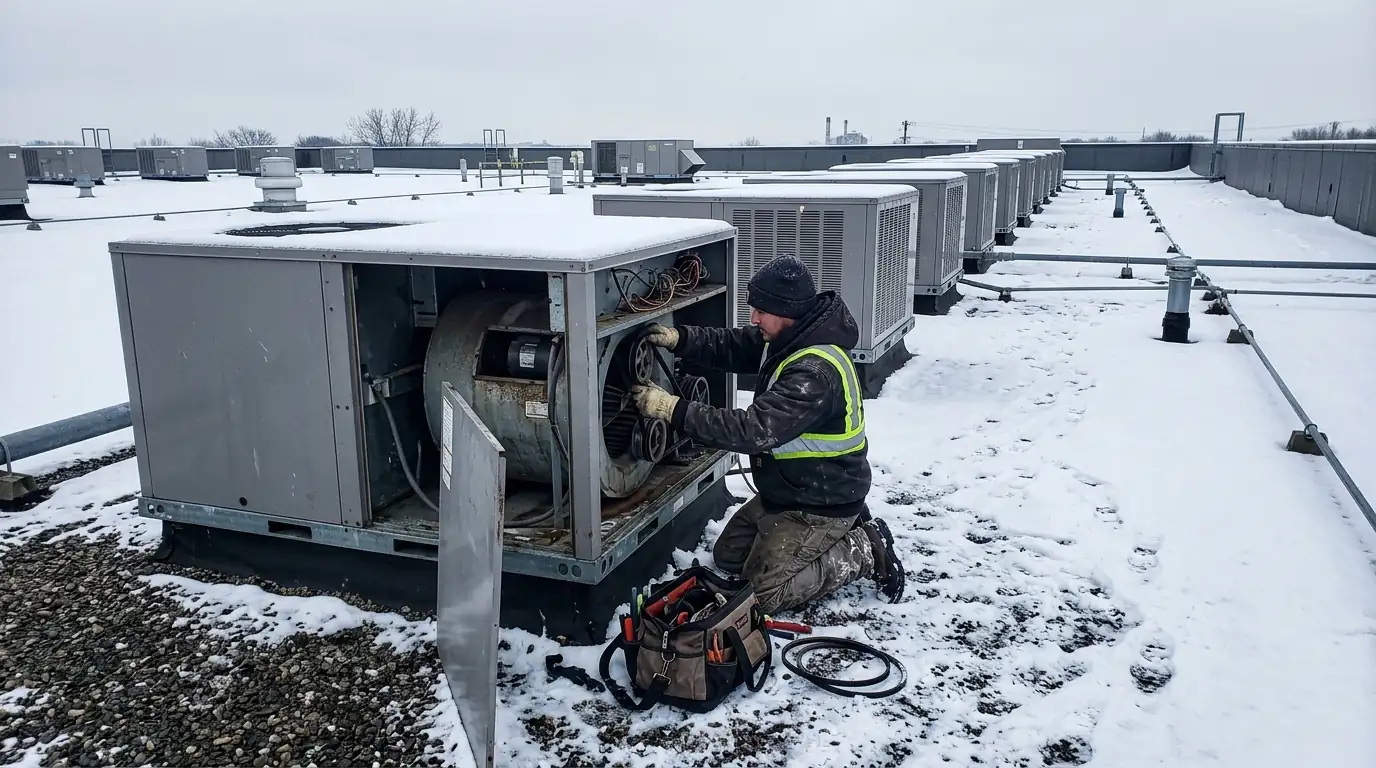
Rooftop unit service means inspecting and repairing a packaged RTU on the roof: changing filters and belts, cleaning coils, testing the gas heat section and heat exchanger, checking refrigerant pressures, and confirming the economizer dampers move correctly. Most units need service twice a year, before heating season and before cooling season, plus repairs as they come up.
Packaged rooftop units, often called RTUs, put the whole heating and cooling system in one cabinet on the roof: compressor, condenser coil, evaporator coil, blower, gas heat section and controls. That design saves floor space inside, but it also means the equipment lives exposed to Southwest Michigan weather all year, with snow drifting against the cabinet and summer sun baking the panels.
Our technicians service and repair rooftop units from 3 to 25 tons on retail buildings, offices, restaurants, medical suites, churches and small manufacturing shops. We handle the whole unit, from the gas heat section and the economizer dampers to belts, bearings, coils and refrigerant circuits, and we leave notes on what we found so you know where each unit stands.
A glazed or loose blower belt makes noise before it breaks, and a broken belt stops airflow to the entire zone.
An economizer stuck open pulls in humid outside air, raising indoor temperature and humidity even while the compressor runs.
Frost on the suction line or evaporator usually means a dirty filter, a failed blower or low charge.
A dirty flame sensor, a cracked igniter or a blocked flue cap often causes short heating cycles on RTUs.
A plugged condensate trap or a rusted drain pan can overflow into the roof curb and leak into the space.
Wind and snow load can loosen access panels, letting water and debris into the cabinet and the electrical section.
Each service visit starts with the basics that keep air moving: filters changed, the blower belt checked for wear and tension, pulleys checked for alignment and bearings checked for play. From there the technician cleans or rinses the condenser coil, checks the evaporator coil and drain pan, and clears the condensate trap. These simple items prevent a large share of summer service calls on rooftop equipment.
The technician then tests the cooling circuit by reading suction and discharge pressures, superheat and subcooling, and comparing them to the manufacturer's charts. On the heating side, we check the inducer, igniter, flame sensor, gas pressure and the heat exchanger tubes for cracks or rust. Electrical connections are tightened and contactors and capacitors are tested under load before we close the panels.
Many rooftop units have an economizer, a set of dampers that brings in outside air to cool the space on mild days and minimum ventilation the rest of the time. When the actuator fails or the linkage seizes, the dampers can stick wide open or closed. Wide open in January means frozen coils and cold complaints. Wide open in August means a compressor that runs nonstop and still cannot keep up.
We test the actuator, the outdoor air sensor and the controller, and we watch the dampers move through their full range. Seized linkages get cleaned and lubricated, bad actuators get replaced, and minimum outdoor air settings are checked against what the space needs. For restaurants and offices with a lot of occupants, a working economizer has a noticeable effect on comfort and on the cooling bill.
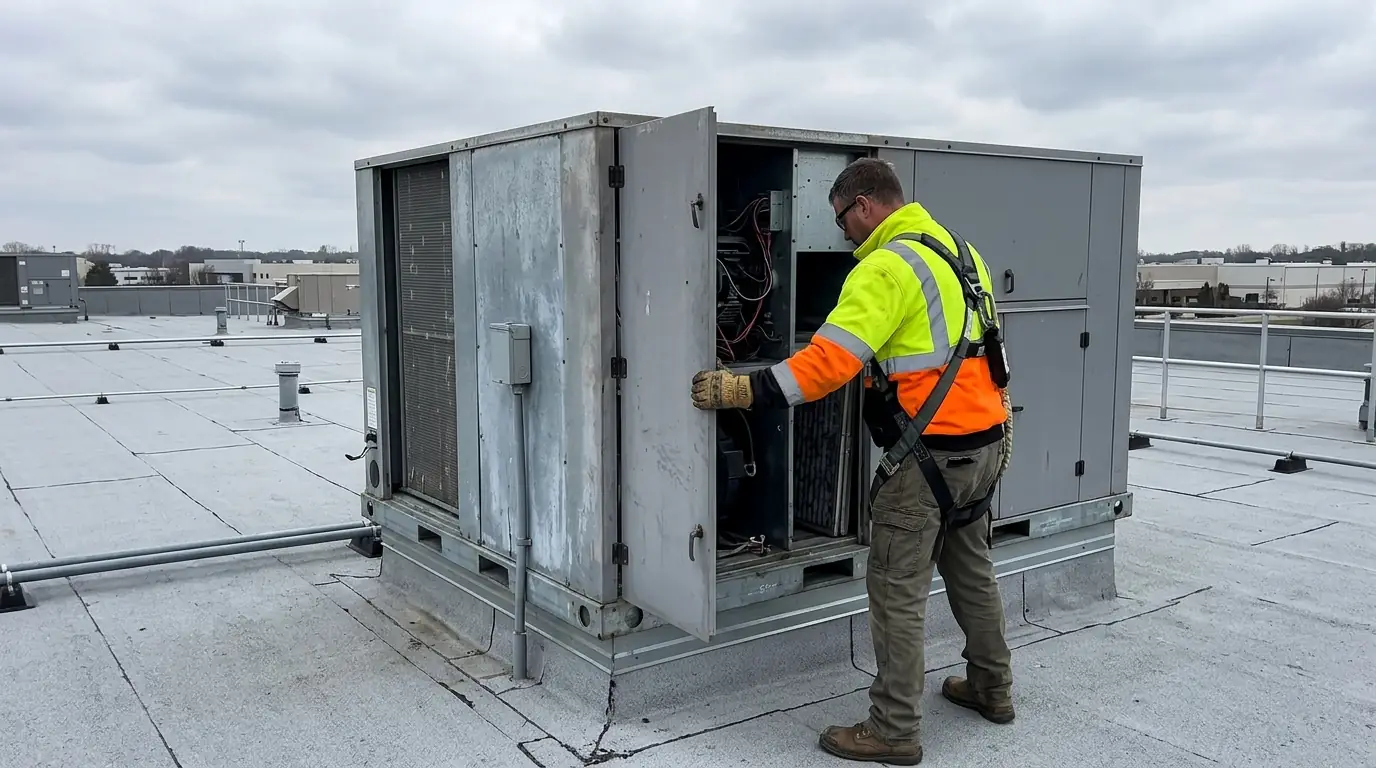
Lake-effect snow is hard on rooftop equipment. Drifts pile against the condenser and intake hoods, ice forms around the flue cap and meltwater can find its way under loose panels. After a heavy storm, a heating section that suddenly stops can be as simple as a vent cap packed with snow. Shore towns like St. Joseph and South Haven also see damp lake air that speeds up corrosion on coils and cabinets.
Summer brings cottonwood seeds, leaves and dust that mat over condenser coils, cutting airflow and pushing head pressure up. We look at the roof curb and the seal around the unit, the condition of the gas line and its supports, and the electrical disconnect. If something on the roof is not ours to fix, like the membrane itself, we point it out so you can call the right trade.
Rooftop units commonly last somewhere around 15 to 20 years, depending on how they were maintained and how hard they ran. Toward the end of that range, failures tend to stack up: a compressor goes, then a heat exchanger cracks, then the cabinet rusts through at the base rail. We give you the repair price and an honest read on the rest of the unit so the choice is clear.
When replacement makes sense, a new unit can often sit on the existing curb with an adapter, which keeps the roof work limited and shortens the time your space is without heating or cooling. Our light commercial installation team handles crane lifts, curb adapters and startup. If the unit still has years left, a scheduled maintenance agreement helps keep it there with service visits every spring and fall.
| Work | Typical range |
|---|---|
| Seasonal RTU service visit (per unit) | $187 to $394 |
| Blower belt and pulley replacement | $163 to $447 |
| Economizer actuator replacement | $538 to $1,170 |
| Condenser coil cleaning (chemical wash) | $219 to $486 |
| Inducer or igniter replacement on gas heat | $342 to $895 |
Costs vary with unit tonnage, roof access and the age of the equipment. The final price is set after the technician inspects the unit on the roof. Compare more jobs in the furnace and AC price guide.
Keep reading
Heating and cooling repair for restaurants, offices, retail shops, churches and light industrial buildings, at any hour.
Learn moreScheduled spring and fall maintenance for small business HVAC, with unit records, filter schedules and priority repair calls.
Learn moreNew and replacement rooftop units, split systems and unit heaters for small businesses, sized to the space and its occupancy.
Learn moreFAQ
Twice a year works for most buildings: once in spring before cooling season and once in fall before heating season. Restaurants and buildings with heavy dust or cottonwood exposure may need filter changes more often. Units that skip service tend to fail during the first hot or cold stretch of the season.
Ice on a rooftop unit usually comes from low airflow or low refrigerant. A clogged filter, a broken blower belt or a dirty evaporator coil cuts airflow, and the coil drops below freezing. A refrigerant leak does the same thing. Turn the cooling off, leave the fan on and call so the cause can be found.
Yes. Drifts can block the combustion air intake or the flue cap, and the unit's safety switches will shut the burner off. Clearing the snow sometimes restores heat, but only do this if the roof is safe to walk. Our technicians can also check whether the vent design needs a change.
An economizer is a set of motorized dampers that brings in outside air when it is cool enough to help with cooling, and a minimum amount of fresh air the rest of the time. If it sticks open or closed, comfort, humidity and operating costs all suffer, so we test it on every visit.
Often it can. If the new unit has the same footprint, it sits right on the old curb. When the footprint differs, a curb adapter bridges the two, which avoids cutting a new opening in the roof. Our technician measures the curb and duct openings before quoting a replacement.
Call any hour. Our office answers, sets the visit and tells you what to expect before a technician arrives.