Outdoor unit stays frozen
Light frost that clears every 30 to 90 minutes is normal. A solid block of ice that never melts points to a defrost board, sensor or airflow fault.
Your heat pump is running nonstop, the outdoor unit is caked in ice, or the house only warms up when the backup strips kick on and the electric meter spins.
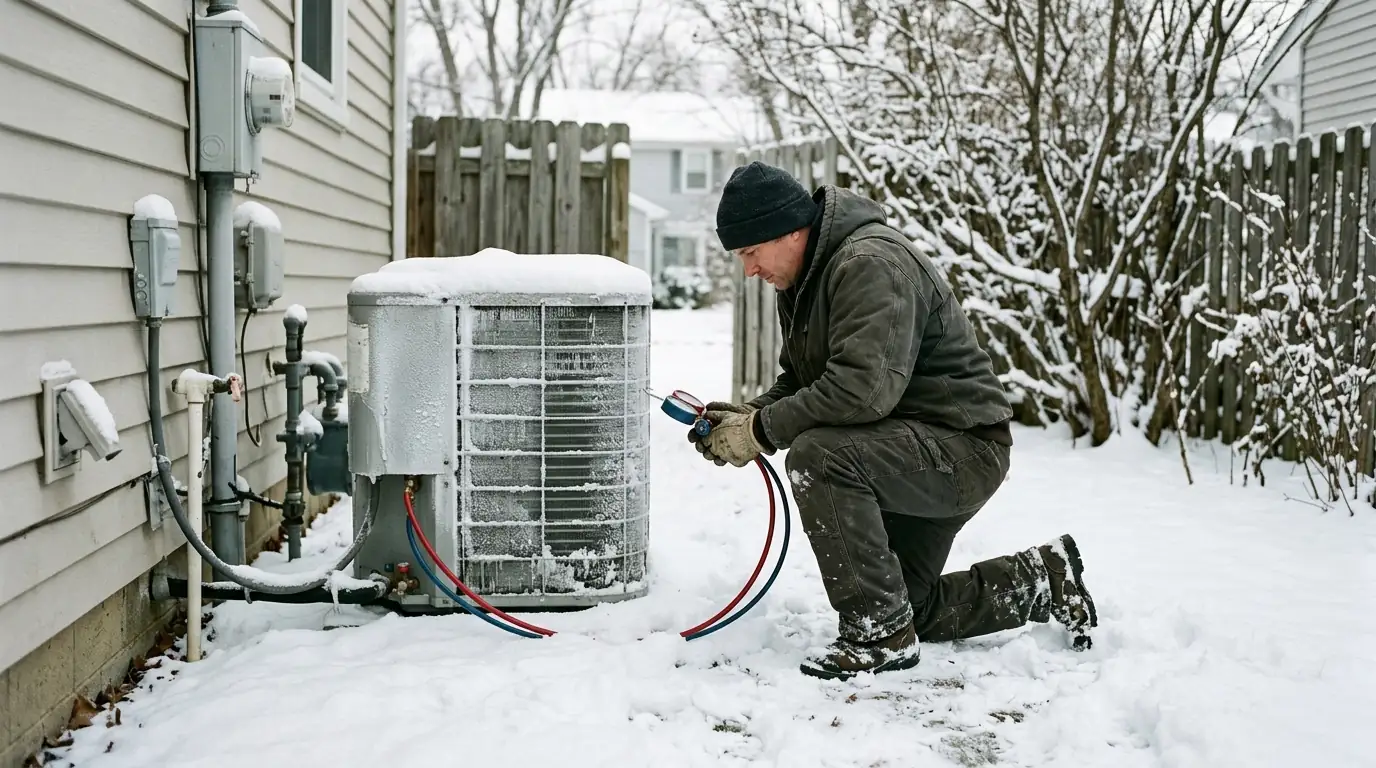
Most heat pump repairs come down to a few parts: the defrost control, the reversing valve, the outdoor fan motor, the start capacitor or a refrigerant leak. A technician measures pressures, temperatures and electrical draw to find the fault. Typical Kalamazoo repairs run $219 to $1,340, depending on the part and whether refrigerant work is needed.
A heat pump moves heat instead of making it, so small faults show up as big comfort problems. A sticky reversing valve, a failed defrost sensor or a slow refrigerant leak can leave you with air that feels cool at the register even though the system never shuts off. In Kalamazoo, where January nights drop below zero, those faults tend to surface on the coldest week of the year.
Our technicians test the whole refrigerant circuit and the controls that run it, then explain what failed in plain terms. We repair air-source heat pumps, cold-climate models and the outdoor half of dual-fuel setups. Every repair comes with a price before the work starts, and the phone at (269) 360-5258 is answered around the clock, so you can reach a person at any hour.
Light frost that clears every 30 to 90 minutes is normal. A solid block of ice that never melts points to a defrost board, sensor or airflow fault.
Supply air from a working heat pump often feels mild, but if it reads close to room temperature the system is not moving enough heat.
If the thermostat shows auxiliary or emergency heat for hours on a 30 degree day, the heat pump side is not carrying its share.
A system that blows the wrong temperature for the mode usually has a reversing valve or valve coil problem.
A whoosh during defrost is normal. Grinding, rattling or a buzzing unit that will not start suggests a fan motor, contactor or capacitor failure.
A sharp rise with no change in weather often means the resistance strips are doing the work the compressor should be doing.
The visit starts at the thermostat, because a miswired or misconfigured stat can lock out the compressor or call for backup heat too early. From there we check the outdoor unit: the contactor, the run and start capacitors, the fan motor and blade, and the condition of the coil fins. We read suction and discharge pressures and compare them to the outdoor temperature, since a heat pump at 10 degrees should look very different from one at 40.
Indoors, we look at the air handler blower, the filter, the backup heat strips and their sequencers. We measure the temperature rise across the coil to see how much heat the system is really delivering. If the numbers point to low charge, we move to leak testing rather than just adding refrigerant, because a recharge without a repair only buys a few weeks.
As outdoor air gets colder, a standard heat pump has less heat to pull from it and its output drops. Older units can lose much of their capacity once temperatures fall into the teens, which is why the backup strips exist. Cold-climate models hold their output much better, but they still depend on clean coils, a correct charge and a defrost cycle that works on schedule.
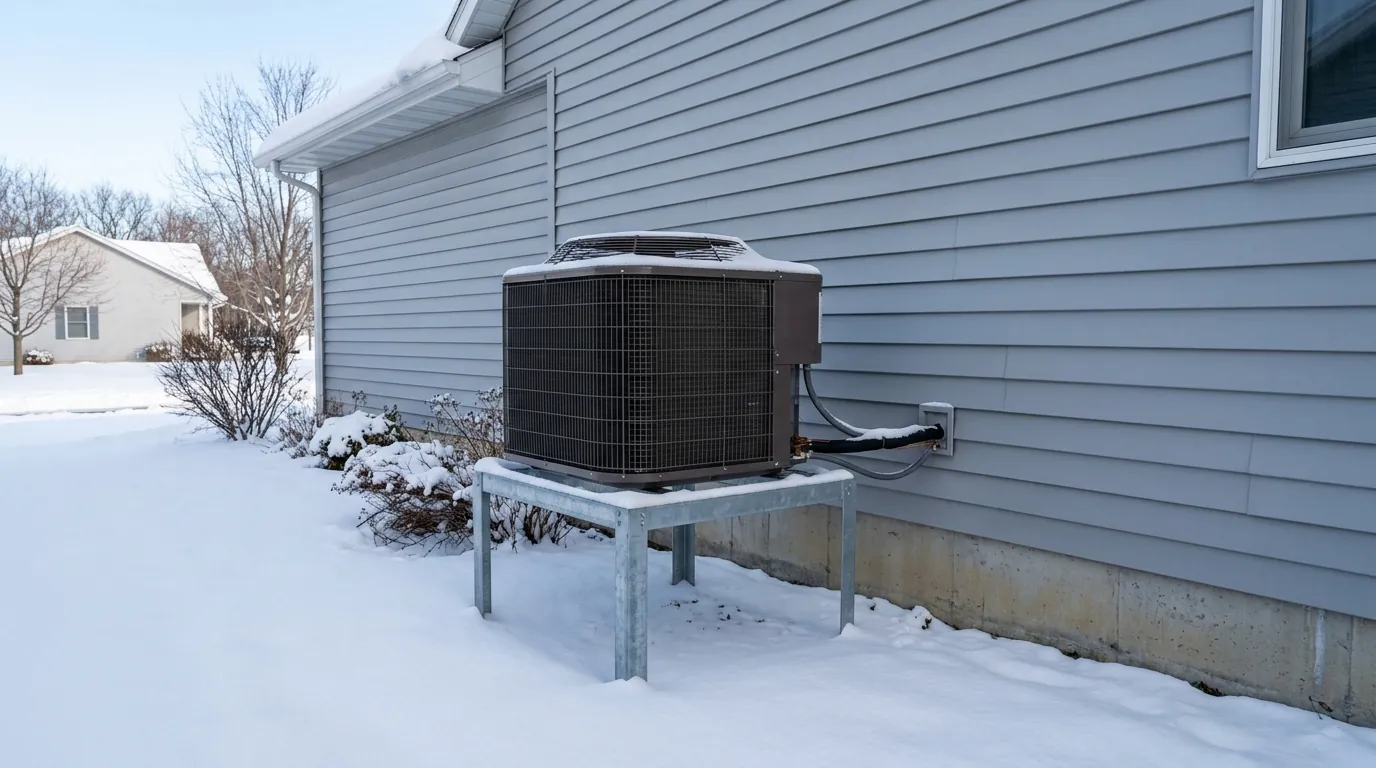
Lake-effect snow adds its own trouble. Drifts can bury the outdoor unit, and melting snow from the roof can drip onto the coil and refreeze into a shell of ice. We often find units set too low on the pad or sitting under a valley in the roofline. Raising the unit on a stand or adding a small roof diverter can stop the same freeze from coming back every storm.
A failed capacitor, contactor or defrost sensor is a modest repair on almost any heat pump. The decision gets harder when the compressor or reversing valve fails on a unit past 12 to 15 years, or when a leak keeps returning in the outdoor coil. In those cases we price the repair and a replacement side by side so you can compare them on the same sheet.
We also look at how the system has been performing. If your heat pump has always handed most of January to the backup strips, a newer cold-climate unit or a dual-fuel setup with a gas furnace may cost less to run. If the system has been reliable for years and only one part failed, repair is usually the sensible call.
Most repeat breakdowns trace back to airflow and debris. Change the filter every one to three months during heating season, keep shrubs and fencing at least two feet from the outdoor unit, and brush loose snow off the top and sides after a storm. Never chip ice off the coil with a tool, because the fins and tubing tear easily.
A spring and fall visit catches worn capacitors and drifting refrigerant charge before they strand you. During those visits we clean the coil, test the defrost cycle, tighten electrical connections and check the backup heat. Many owners pair the heat pump with a smart thermostat set up for heat pump staging, which keeps the strips from kicking on every time someone bumps the setpoint.
| Work | Typical range |
|---|---|
| Diagnostic visit | $89 to $149 |
| Capacitor, contactor or defrost sensor | $219 to $487 |
| Outdoor fan motor replacement | $394 to $812 |
| Reversing valve replacement | $1,140 to $2,365 |
| Leak repair with recharge | $487 to $1,340 |
Heat pump repair prices around Kalamazoo usually fall in these bands. Your technician sets the final price after testing the system and shows it to you before any work begins. Compare more jobs in the furnace and AC price guide.
Keep reading
Cold-climate heat pumps sized to your home with a load calculation, set up to heat through January and cool in July.
Learn moreA heat pump paired with a gas or propane furnace, switching between the two so each runs when it costs the least.
Learn moreRepairs for mini-split heads that drip, flash error codes, blow weak air or stop heating when the weather turns cold.
Learn moreFAQ
Yes. During a defrost cycle the unit briefly reverses to warm the outdoor coil, and the melting frost gives off a cloud of steam. The outdoor fan stops for a minute or two and you may hear a whoosh. It becomes a problem only if ice keeps building and the cycle never clears it.
If the outdoor unit is iced solid, making grinding noises or not running at all, switching to emergency heat protects the compressor and keeps the house warm. It costs more to run, so treat it as a short-term measure. Call (269) 360-5258 and let the technician know you made the switch.
A cold-climate heat pump can keep producing useful heat well below zero, though its output drops as the temperature falls. Older standard models lean heavily on backup strips in that range. If yours cannot keep up even with backup heat on, something is wrong with the system rather than the weather.
A breaker that trips at startup usually points to a weak start capacitor, a shorted fan motor, a compressor drawing locked-rotor current or a loose connection at the disconnect. Repeated resets can damage the compressor, so leave the breaker off and have the electrical side tested before running the unit again.
Because a heat pump runs in both winter and summer, it logs more hours than a central air unit. Many last 12 to 15 years here with regular care. Units near the lakeshore can wear faster where damp air corrodes the coil and fasteners, so coil condition is part of every repair visit.
Call any hour. Our office answers, sets the visit and tells you what to expect before a technician arrives.