Hot water runs out every morning
If showers back to back drain your tank, an on-demand unit removes that limit when sized for your peak use.
Running out of hot water halfway through the second shower, or losing floor space to a tank that keeps getting older, is often what starts the tankless conversation.
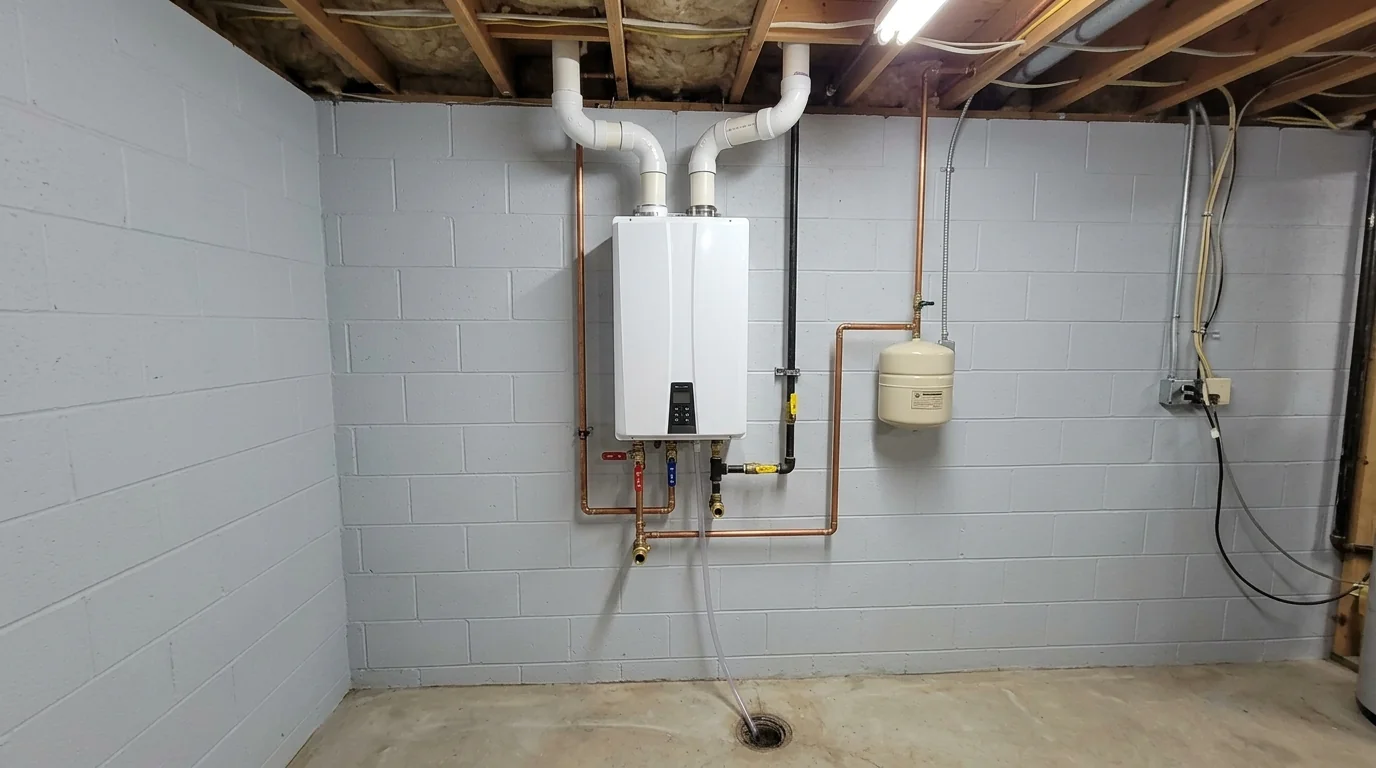
A tankless water heater can supply steady hot water for a family, but only if its gas input and flow capacity match winter inlet temperatures. Most whole-home gas units need a larger gas line and new stainless or PVC venting. Installed cost in Southwest Michigan typically runs higher than a tank, while operating cost is usually lower.
A tankless heater, also called an on-demand heater, warms water only while a tap is open. Instead of keeping 50 gallons hot around the clock, a burner fires when it senses flow and shuts off when you close the faucet. For a busy household with teenagers or guests, that means hot water that keeps coming as long as the unit is sized correctly.
Sizing is where many tankless installs go wrong in Michigan. Winter water entering a Kalamazoo home can be in the low 40s, so the heater has to raise it 70 degrees or more. Our technicians size each unit to your fixtures and that winter temperature rise, then plan the gas line, venting and condensate drain in detail before any work begins.
If showers back to back drain your tank, an on-demand unit removes that limit when sized for your peak use.
Replacing an aging tank is the natural time to look at tankless, since the plumbing is already being opened up.
A wall-mounted unit frees up the corner of a basement or utility room that a tank and its drain pan used to fill.
A tank that cannot keep up with a soaking tub or a second bathroom addition is a sign the household has outgrown it.
Ignition, flame or flow codes on an older on-demand unit can point to scale buildup or a sizing problem we can sort out.
Adding a bathroom changes your hot water demand, and a tankless unit can be planned alongside the new fixtures.
Every tankless heater has a flow capacity that drops as the required temperature rise goes up. A unit rated for nine gallons a minute on a mild day might deliver closer to five in January here. We count the fixtures likely to run at once, such as a shower, a kitchen faucet and a washing machine, and match that flow to a unit that can handle a 70 to 75 degree rise.
For many three and four bedroom homes, that points to a condensing gas unit in the range of 180,000 to 199,000 BTU. Smaller homes, condos and cottages with one bathroom may do well with less. Electric tankless units exist, but whole-house models draw very large current, and most Kalamazoo homes do not have the electrical service to support one without major panel work.
A whole-home tankless heater can draw several times the gas of a standard tank, and the half-inch line that fed your old heater is often too small. We check the length of the run, the size of the gas meter and the other appliances on the line, then upsize the pipe where needed. Undersized gas supply is the most common reason a newly installed tankless unit flickers or throws flame errors.
Condensing tankless heaters vent through PVC or polypropylene pipe out a side wall or the roof, and they produce acidic condensate that needs a drain and usually a neutralizer. Non-condensing models need stainless steel vent pipe. We plan the termination away from windows and above the typical snow line, since lake-effect drifts can block a low vent and shut the heater down.
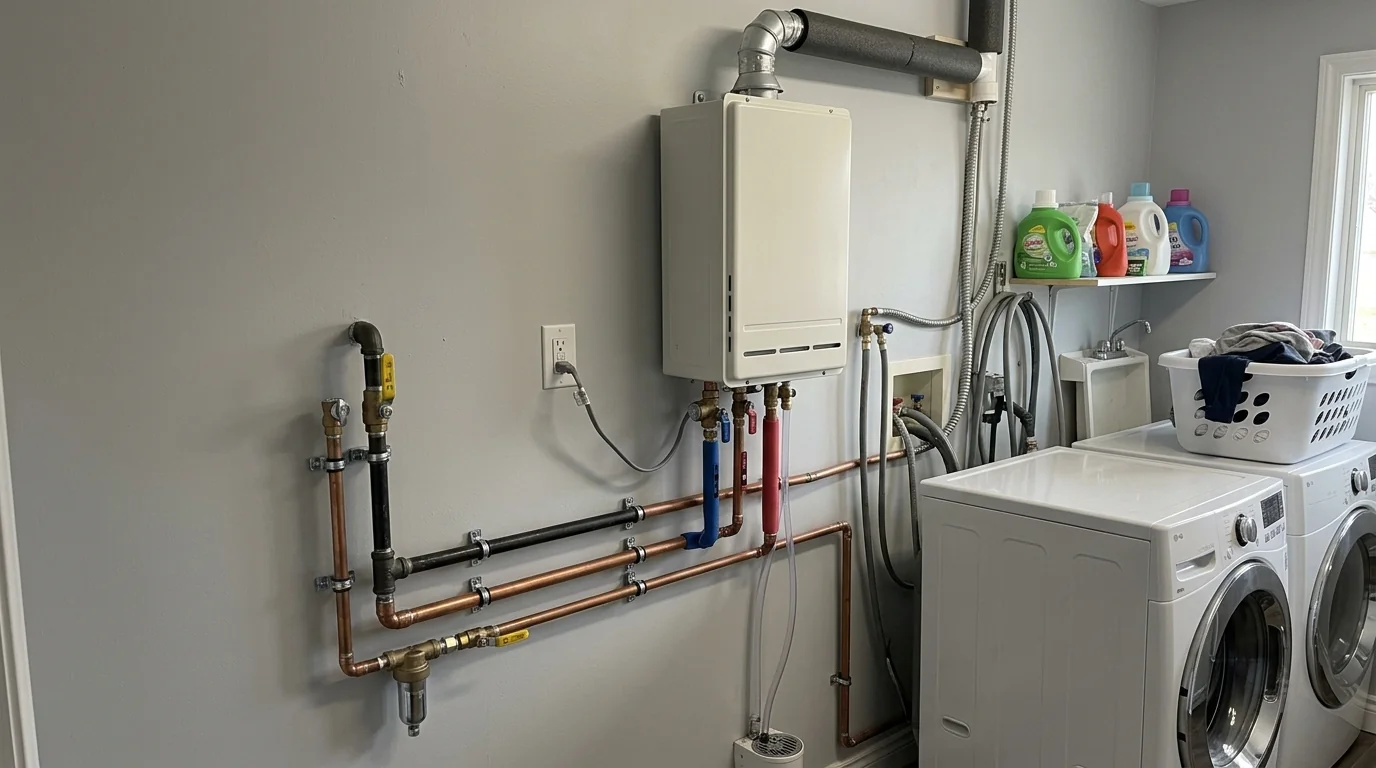
Minerals in Southwest Michigan water are hard on the small heat exchanger passages inside a tankless unit. As scale builds up, the heater has to work harder, flow drops and error codes start to appear. That is why we install service valves on every unit, so the heat exchanger can be flushed with a pump and descaling solution without cutting into the plumbing.
Homes on city water usually need descaling about once a year. Homes on private wells with high hardness or iron may need it more often, and a water softener ahead of the heater can make a big difference. We test the water hardness during the estimate visit so you know exactly what upkeep to expect before you choose a unit.
Tankless is not the right answer for every house. Installation costs more, because of the gas line, venting and drain work, and it takes years of lower gas bills to make that back. A household of one or two people with modest hot water use may be better served by a quality tank. We will tell you plainly which one fits your home and your budget better.
Where tankless really shines is in larger households with staggered schedules, homes with a big soaking tub, and homeowners who plan to stay long enough to see the payback. Some families pair a tankless unit with a yearly maintenance plan so descaling is handled on schedule. If a tank still suits you better, our water heater replacement service covers that too.
| Work | Typical range |
|---|---|
| Condensing gas tankless unit, installed | $3,480 to $5,870 |
| Gas line upsizing to the heater | $385 to $1,140 |
| New PVC or stainless venting | $295 to $860 |
| Condensate drain and neutralizer | $137 to $318 |
| Annual descaling service | $169 to $289 |
Ranges reflect typical Southwest Michigan installs. Your final price is set after the technician measures the gas run, vent path and water hardness, and the estimate visit has no charge. Compare more jobs in the furnace and AC price guide.
Keep reading
Gas and electric tank water heater repair, plus same-day replacement when an old tank is leaking or out of hot water.
Learn moreNew gas piping for furnaces, ranges, dryers, generators, garage heaters and outdoor grills, sized for load and pressure tested.
Learn moreTwo visits a year, furnace in fall and AC in spring, with priority scheduling when your home needs a repair.
Learn moreFAQ
It will if the unit is sized for winter inlet water, which can drop into the low 40s here. Two showers usually need around four to five gallons a minute at a 70 degree rise, and a properly sized condensing gas unit can supply that. An undersized unit will not.
A whole-home tankless unit can fire at close to 200,000 BTU, far more than a standard tank. If the pipe is too small for that demand plus your furnace and stove, the burner starves for gas, the water temperature swings and the heater may shut down with an error code.
On city water, about once a year is typical. Homes on hard well water may need it every six to nine months. Descaling takes about an hour using the service valves we install, and skipping it is one of the main reasons tankless units lose flow and fail early.
Yes. Most gas tankless models come in propane versions or can be converted with a kit from the manufacturer. Propane units need the right regulator and line pressure, and we confirm the propane supply can deliver the full input before installing one in a rural home.
The heater itself warms water within seconds, but the water already sitting in the pipes still has to clear, just as with a tank. Some homeowners add a recirculation setup or a small buffer tank to shorten that wait. We can discuss whether either makes sense for your layout.
Call any hour. Our office answers, sets the visit and tells you what to expect before a technician arrives.