Needs a recharge every year
A system that is topped off each spring and runs low by August is leaking. The leak will not seal itself.
Your air conditioner or heat pump needed refrigerant last year, and now it is blowing warm again, the line is icing up, or you hear a faint hiss near the coil.
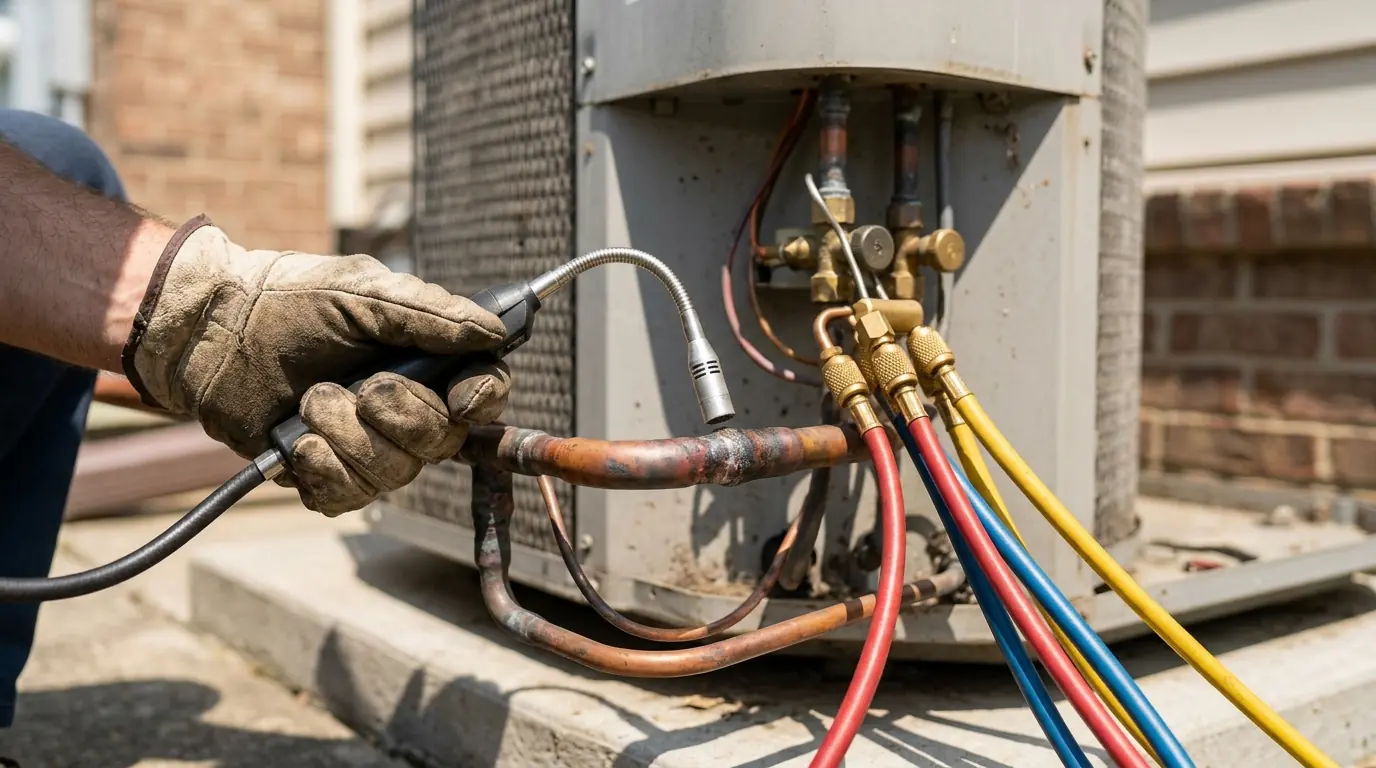
Refrigerant leak repair starts with finding the leak using an electronic detector, bubble solution or a nitrogen pressure test. Common leak spots are the evaporator coil, Schrader valve cores, flare joints and line sets rubbed against framing. In Kalamazoo, typical leak repairs with recharge run $296 to $1,480, while a leaking coil may call for coil replacement.
Refrigerant does not get used up. It circulates in a sealed loop, so a system that runs low has a leak somewhere, even if it is tiny. Adding charge without finding the leak only resets the clock. Within a few weeks or a season, the system runs low again, the coil freezes, and the compressor works harder with less cooling oil returning to it.
Our technicians find the leak first, then give you a choice of repairs with prices. We use electronic detectors, bubble solution and nitrogen pressure testing to locate leaks in coils, line sets, flare joints and service valves. Once the repair is made, we evacuate the system and charge it by weight. The line at (269) 360-5258 is answered around the clock.
A system that is topped off each spring and runs low by August is leaking. The leak will not seal itself.
Low charge drops coil pressure and temperature until moisture freezes on the coil and the copper line outside.
A larger leak can make a faint hiss near the coil, the line set or the outdoor service valves.
Refrigerant carries compressor oil, so a leak often leaves a dark, oily film right where it escapes.
The system runs all afternoon and the house still creeps up a degree or two above the setting.
Low charge cuts heating output and makes defrost cycles less effective, so backup heat runs more often.
The indoor evaporator coil is the most common leak location we find in Kalamazoo homes. Thin copper or aluminum tubing in the coil can develop pinholes over time, often from corrosion that starts on the outside of the tubes. Basements with high humidity and household chemicals stored nearby, such as cleaners or paint, can speed that corrosion along over several summers.
Other frequent spots are the Schrader valve cores at the service ports, brazed joints at the outdoor unit, flare connections on ductless systems and line sets that rub against joists or a sharp edge where they pass through a wall. Vibration from the compressor slowly wears a hole wherever copper touches something hard. We check each of these in order before calling it a coil leak.
We start with an electronic leak detector, a handheld sniffer that reacts to small amounts of refrigerant in the air. It is most useful on outdoor joints and accessible sections of the coil. When it alerts, we confirm with bubble solution, which foams over the exact point of escape. Service valve cores get a separate check because they leak more often than people expect.
If the leak is too small to find that way, we recover the remaining refrigerant and pressurize the system with dry nitrogen. Higher test pressure makes small leaks easier to hear and bubble. On coils hidden inside a sealed cabinet, we may isolate the coil from the rest of the system to prove whether the leak is there before recommending any replacement.
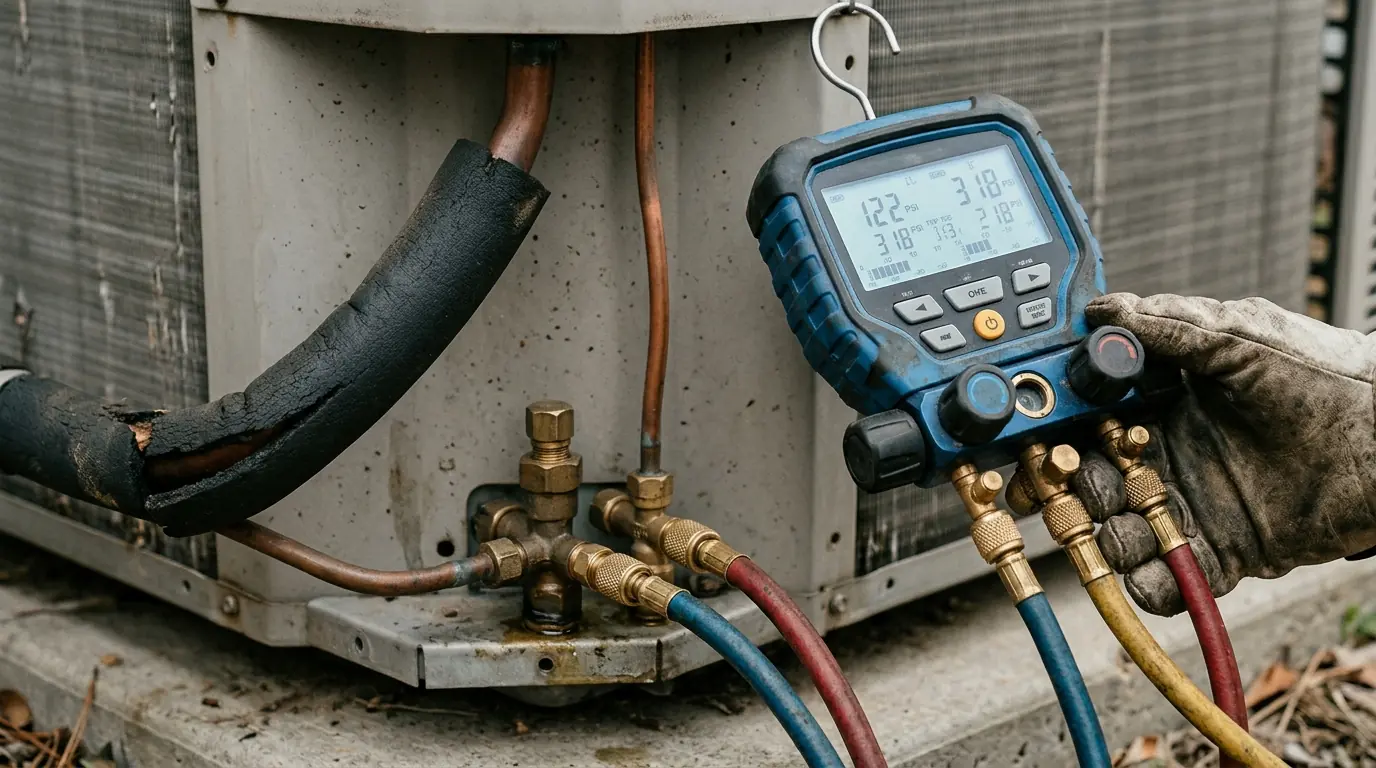
Leaks at valve cores, flare nuts and accessible brazed joints are usually straightforward. We replace the core, re-flare the fitting or rebraze the joint, then pressure-test the system and recharge it. Line set leaks caused by rubbing are repaired by cutting out the damaged section and brazing in new copper, then adding a sleeve or bushing so it does not happen again.
Coil leaks are a different decision. Patching a pinhole in a coil is possible in some cases, but corrosion rarely stops at one spot. On a system under 10 years old, coil replacement under the manufacturer warranty parts coverage may be available, with labor billed separately. On older systems, evaporator coil replacement or a full system change are compared side by side.
Once a leak is repaired, the system needs to be pulled into a deep vacuum to remove air and moisture that got in while it was open. Moisture mixed with refrigerant and oil forms acids that eat away at compressor windings over time. We pull vacuum with a micron gauge and wait to confirm the system holds before charging, which also proves the repair is tight.
Charging by weight or by superheat and subcooling readings puts the system back to the amount the manufacturer specifies. Overcharging is as harmful as undercharging, so we do not guess. After the job, we recheck readings with the system running in humid weather conditions. A system that was low for a long time may have stressed its compressor, so we also check compressor health during the visit.
| Work | Typical range |
|---|---|
| Leak search with electronic detection | $169 to $347 |
| Valve core or flare fitting repair with recharge | $296 to $684 |
| Brazed joint or line set repair with recharge | $487 to $1,180 |
| Nitrogen pressure test for hard-to-find leaks | $214 to $468 |
| Coil isolation test and repair quote | $186 to $394 |
Refrigerant cost depends on the type and amount your system uses, so the recharge portion varies. The technician confirms the total before any work begins. Compare more jobs in the furnace and AC price guide.
Keep reading
Replacement of leaking or corroded indoor AC coils, matched to your outdoor unit and furnace so the system cools at full strength.
Learn moreCentral air repair for systems that blow warm, freeze up, trip breakers or leave the house sticky on a humid July day.
Learn moreTesting and repair for AC compressors that hum, trip breakers, run hot or will not start, plus honest replace-or-repair advice.
Learn moreFAQ
Modern refrigerants are low in toxicity at the levels a home system leaks, and most escape outdoors or disperse quickly. A large leak in a small, closed room can displace oxygen, so open windows if you hear a strong hiss indoors. Burning refrigerant from contact with a flame can create harmful gases, so keep sparks away from a leak.
Topping off without a repair often costs more over time. The charge leaks out again, sometimes within weeks, and the compressor runs low on returning oil during that time. Repeated recharges add up quickly, and a compressor damaged by running low is far more expensive than the leak repair would have been.
A straightforward search on an accessible system usually takes 45 minutes to two hours. Small leaks hidden inside a coil cabinet or behind finished walls can take longer, especially if a nitrogen pressure test is needed. We keep you updated during the search so you know where things stand.
Formicary corrosion is a type of pinhole corrosion in copper coil tubes, linked to certain household chemicals and humid conditions. It shows up in Michigan basements as tiny leaks spread through the coil. When we find that pattern, coil replacement is usually more practical than patching, because more pinholes tend to follow.
Most homeowners policies treat wear and corrosion leaks as maintenance rather than covered damage. Leaks caused by a sudden event, such as a falling tree branch or a lightning strike, may be handled differently. We document what we find and what caused it, which helps if you decide to talk with your insurer.
Call any hour. Our office answers, sets the visit and tells you what to expect before a technician arrives.