Heavy dust on registers and furniture
Gray film around supply registers and fast-returning dust usually means fine particles are passing straight through the filter.
Dust settling on furniture days after cleaning, a musty smell from the vents when the AC starts, or a slimy evaporator coil are signs your system is moving more debris than its filter can catch.
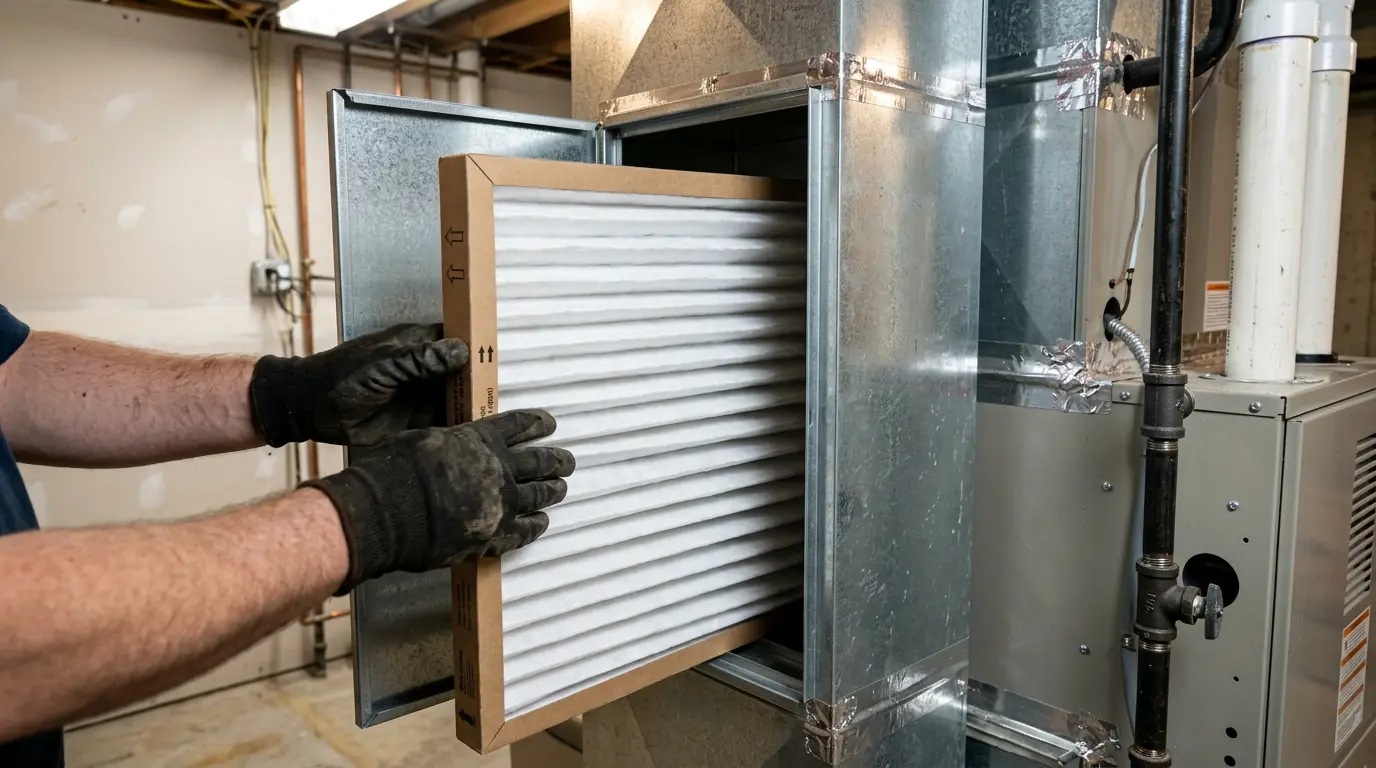
Whole-home air purifiers mount in the return duct beside your furnace or air handler and clean all air the blower moves. A four or five inch media cabinet captures fine particles with little airflow loss. UV lamps install near the evaporator coil, where they keep the wet coil surface and drain pan cleaner. Most installs take two to four hours.
Your furnace blower moves every cubic foot of air in the house through one spot: the filter slot. That makes the air handler the most effective place to clean the air, far more than a tabletop unit in one room. The catch is that the thin one-inch filter many systems came with is designed to protect the blower, not to capture fine dust, pollen or smoke particles.
Our technicians install whole-home air cleaning at the furnace or air handler, sized to its airflow so the blower does not strain. Options include deep pleated media cabinets, electronic air cleaners and ultraviolet lamps aimed at the cooling coil. Each choice depends on what you want to capture, how your return ducts are built and how much upkeep you are willing to handle through the year.
Gray film around supply registers and fast-returning dust usually means fine particles are passing straight through the filter.
A damp, sour smell in the first minutes of an AC cycle often comes from growth on a wet evaporator coil or drain pan.
A loose one-inch filter in an oversized slot lets air slip around the edges, carrying dust into the blower and coil.
Hair and dander circulate with the blower, and a basic filter loads up quickly and stops capturing much of anything.
Fine smoke particles pass through low-grade filters and linger indoors long after the source is gone.
Buildup on the evaporator coil cuts cooling capacity and is a sign that filtration upstream needs improvement.
A media filter cabinet replaces the thin filter slot with a sealed housing that holds a four or five inch deep pleated filter. All that extra surface area lets it trap much finer particles while keeping airflow resistance low, and the filter typically lasts six months to a year. For most homes in Southwest Michigan, this is the simplest and most cost-effective upgrade we install.
Electronic air cleaners charge particles and collect them on metal plates that you wash every month or two. They capture very fine particles well but need consistent cleaning to keep working. UV lamps work differently: they do not filter the air at all. They shine on the evaporator coil and drain pan, the wettest surfaces in the system, keeping them cleaner so the coil holds its capacity longer.
The biggest mistake with air cleaning is dropping a dense filter into a system that cannot push air through it. Restricted airflow makes a furnace run hotter and can freeze an AC coil in summer. Before recommending anything, our technician measures static pressure across the existing filter and checks how large the return duct is compared with the blower's rated airflow.
Many older homes in Kalamazoo and Battle Creek have a single small return grille feeding a furnace that was later upsized, so the return is already working hard. In those cases a deep media cabinet with more surface area actually lowers resistance compared with the old thin filter. Sometimes we also recommend adding a return, which helps both comfort and filtration at the same time.
Ultraviolet light is most useful on surfaces that stay damp and dark, which is exactly what an evaporator coil is during cooling season. Michigan summers keep the coil wet for hours each day, and organic growth can build up on the fins and in the drain pan. A coil-facing lamp runs continuously and keeps those surfaces noticeably cleaner, which helps airflow, drainage and odors.
UV lamps do not trap dust, pollen or pet hair, and they cannot replace a good filter. Air passes by them too quickly for meaningful effect on particles moving through the duct. We are straightforward about that difference. If your main concern is dust in the house, a media cabinet comes first; if it is a musty coil or a slow drain, UV is a good addition.
Media filters need replacing every six to twelve months, depending on pets, nearby construction and how often the blower runs. A gauge or a simple calendar reminder keeps that on track. Electronic cells need washing in a laundry tub or a dishwasher with the manufacturer's guidance. UV bulbs lose output over time and are typically replaced about once a year.
Our technicians check all of these during a regular tune-up, along with the coil condition, drain pan and blower wheel. If dust and odors persist after filtration is in place, duct cleaning or sealing leaky return joints is usually the next step. An air quality test before and after can show how much the particle counts actually dropped in your home.
| Work | Typical range |
|---|---|
| Four or five inch media filter cabinet, installed | $347 to $718 |
| Electronic air cleaner, installed | $894 to $1,563 |
| Coil UV lamp, installed | $389 to $746 |
| Added return duct to support filtration | $412 to $963 |
| Replacement media filter or UV bulb | $46 to $139 |
Air cleaner installs locally usually fall within these numbers. Your final price is set after the technician measures airflow and sees the furnace and return layout. Compare more jobs in the furnace and AC price guide.
Keep reading
On-site measurement of humidity, particles, carbon dioxide and VOCs, with clear readings tied back to your HVAC system.
Learn moreNegative-pressure duct cleaning with rotary brushes, plus blower and coil checks, for homes with debris built up in the ducts.
Learn moreReplacement of leaking or corroded indoor AC coils, matched to your outdoor unit and furnace so the system cools at full strength.
Learn moreFAQ
Coil lamps sit inside the air handler or duct, out of sight, and the housing blocks direct light. Most models include a door switch that cuts power when a panel is opened. You should not look at the bulb while it is lit, and our technician mounts it so that service access does not expose anyone to the light.
Most deep media filters we install fall in the MERV 11 to MERV 13 range. Because the filter is four or five inches deep, it captures fine particles while still letting the blower move enough air. A one-inch filter at the same MERV value would often restrict airflow much more.
Some electronic designs produce a small amount of ozone as a byproduct of charging particles. Models we install are chosen to keep that output low. If you would rather avoid the question entirely, a deep media cabinet captures fine particles without any electrical charge and is the option many homeowners choose.
Ductless heads have their own washable filters and no shared return duct, so whole-home cabinets do not fit them. Some indoor units accept upgraded filter inserts from the manufacturer. Keeping those filters clean every month or two is the most effective step, along with yearly coil cleaning by a technician.
It can help indirectly. A clean coil and blower wheel move air more easily, and the AC cools better when the coil is not coated in dust. The savings depend on how dirty the system was before. The bigger benefit for most people is less dust in the house and fewer coil cleanings.
Call any hour. Our office answers, sets the visit and tells you what to expect before a technician arrives.