One zone is hot while another is cold
In a building with several rooftop units, one failed unit shows up as a single area that will not hold temperature.
A dining room at 84 degrees on a Friday night, a cold sanctuary on Sunday morning or a warehouse office with no heat costs you customers and staff time until it is fixed.
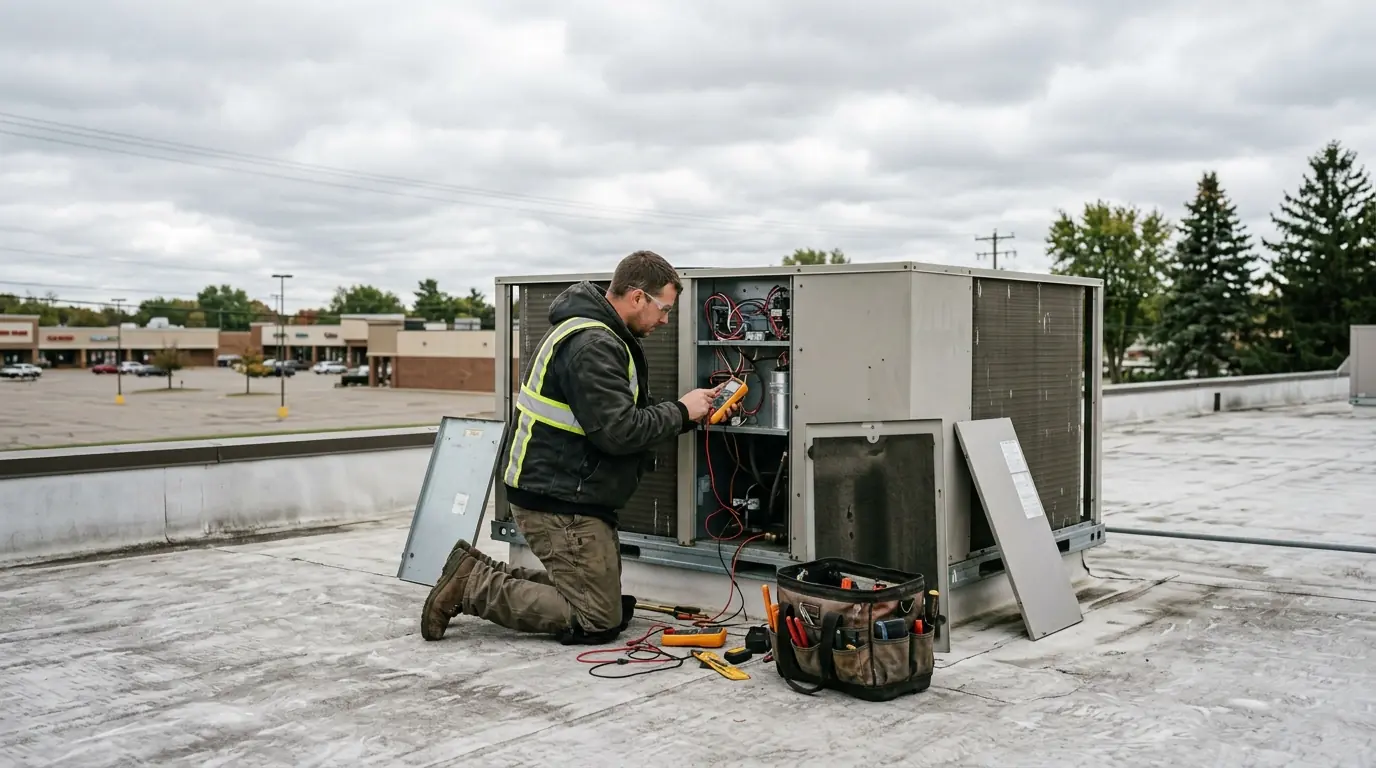
Commercial HVAC repair covers rooftop units, split systems, unit heaters and make-up air equipment in businesses. Common failures include bad contactors, failed capacitors, inducer motors, flame sensors, frozen coils and economizer faults. A technician diagnoses the unit on site, explains the repair and the cost, and in most cases finishes the work on the same visit.
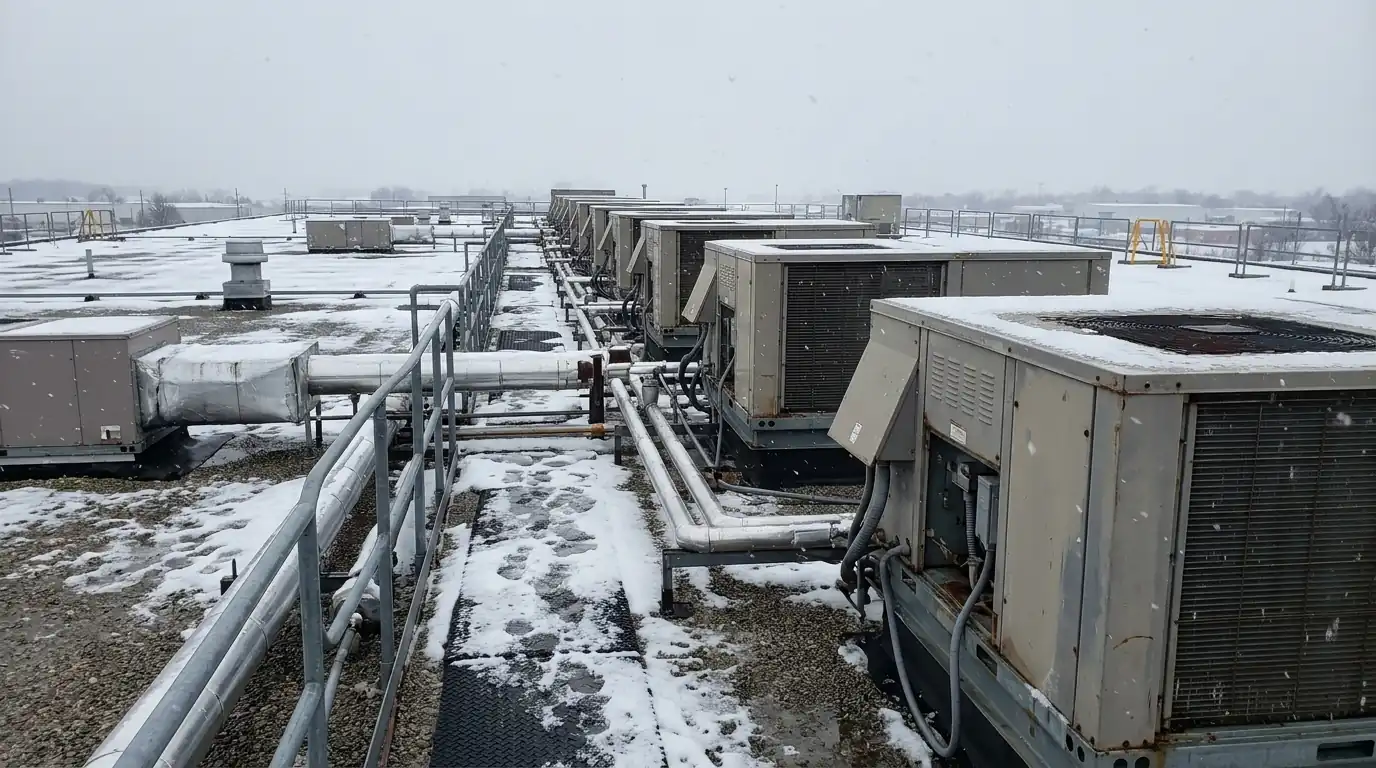
Small commercial buildings in Southwest Michigan run on equipment that looks a lot like residential gear, only bigger and harder working. Packaged rooftop units, split systems with large condensers, gas unit heaters hanging from warehouse ceilings and make-up air units over kitchen hoods all show up on our service calls. Each one has its own failure patterns, its own parts and its own quirks in a Michigan winter.
Our technicians repair heating and cooling systems for restaurants, offices, retail storefronts, churches, clinics and light industrial shops across Kalamazoo, Portage, Battle Creek and the shore towns. We understand that a business cannot wait until next Tuesday, so the phone is answered around the clock, and we work around your hours whenever the repair can safely wait for closing time.
In a building with several rooftop units, one failed unit shows up as a single area that will not hold temperature.
A failed compressor contactor, a bad capacitor or low refrigerant charge can leave the supply fan running without any cooling.
Inducer motor, pressure switch, igniter and flame sensor problems are the usual suspects on gas-fired rooftop and unit heaters.
When a make-up air unit fails, the hood exhaust pulls air from the dining room and the kitchen line gets uncomfortable fast.
Repeated trips at the disconnect usually mean a shorted motor or compressor, which should be checked before it is reset again.
A clogged condensate drain or a cracked drain pan on a rooftop unit can soak ceiling tiles and inventory below.
Most light commercial buildings around Kalamazoo are served by packaged rooftop units in the 3 to 25 ton range, with gas heat and electric cooling in a single cabinet. Older strip centers and churches often have split systems with an indoor furnace or air handler and a condenser on a pad or the roof. Warehouses and shops commonly use gas unit heaters or radiant tube heaters hung near the ceiling.
We also work on make-up air units that feed restaurant kitchens, ductless systems that cool server closets, and boilers in older churches and schools converted to offices. Our technicians carry common motors, capacitors, contactors, igniters and controls, and they can source belts, pulleys and compressor parts from regional supply houses when a less common part is not already on the truck.
A good commercial repair starts with reading the unit before touching it. Many rooftop units have a control board that stores fault codes, and newer ones log the last several faults with time stamps. Our technician checks those codes, then measures voltage, amperage, refrigerant pressures and temperature split across the coil. That gives a clear picture of whether the problem is electrical, mechanical, airflow or refrigerant.
Belt-driven blowers are common on larger units, and a worn or broken belt can look like a cooling failure from inside the building. Economizers are another frequent cause, since a stuck damper can pull in hot outdoor air in July or frigid air in January. We check these simpler causes first, so you are not paying for a compressor diagnosis when the real issue is a twenty dollar belt.
A restaurant cannot have a technician walking through the dining room during the dinner rush, and a dental office cannot lose power to its exam rooms at noon. When the repair allows it, we schedule the work before opening, after closing or during a slow afternoon. When it cannot wait, we keep disruption small by working from the roof and keeping interior visits short.
Property managers with several tenants or several addresses can call one number for every building they oversee. We keep notes on each unit's model, age and past repairs, so the next technician to visit already knows the history. That record also helps when you are planning budgets and deciding which units to repair and which ones are due for commercial replacement.
Most commercial HVAC emergencies trace back to something a routine visit would have caught: a cracked belt, a dirty condenser coil choked with cottonwood fluff, a capacitor that tested weak in April, or a heat exchanger with rust starting at the seams. Rooftop equipment in Southwest Michigan takes a beating from lake-effect snow loads, freeze and thaw cycles and humid summer heat.
After a repair, our technician will note anything else on the unit that looks close to failing and explain how urgent it is. Many of our commercial customers move onto a scheduled commercial maintenance program after their first emergency call, with spring and fall visits timed before the heating and cooling seasons begin. Fewer surprise calls also means fewer days with unhappy customers and staff.
| Work | Typical range |
|---|---|
| Commercial diagnostic visit | $179 to $348 |
| Capacitor, contactor or relay replacement | $227 to $516 |
| Inducer or condenser fan motor replacement | $487 to $1,165 |
| Blower motor and belt drive repair | $396 to $1,480 |
| Refrigerant leak search and repair | $615 to $2,290 |
Commercial repair costs depend on the unit size, roof access and part availability. The final price is set after the technician inspects the equipment, and you approve it before work begins. Compare more jobs in the furnace and AC price guide.
Keep reading
Repair and seasonal service for packaged rooftop units on stores, offices and restaurants, from belts and coils to gas heat.
Learn moreScheduled spring and fall maintenance for small business HVAC, with unit records, filter schedules and priority repair calls.
Learn moreNew and replacement rooftop units, split systems and unit heaters for small businesses, sized to the space and its occupancy.
Learn moreFAQ
Yes. We repair gas-fired and electric make-up air units that supply fresh air to kitchen hoods, along with the rooftop units that cool the dining room. When a make-up air unit fails, the kitchen pulls air from the dining area, so we treat these calls as urgent and try to finish before the next service.
Yes. Property managers can call one number for every location they oversee. We track each unit's model, age and repair history by address, which makes approvals faster and helps you plan repair and replacement budgets across the whole portfolio instead of reacting one building at a time.
Look at the thermostat to confirm it is set to cool or heat and has power. Check the breaker in the electrical panel and, if it is safe, the disconnect switch beside the unit on the roof. If a breaker has tripped more than once, leave it off and call so the cause can be found.
Yes. Churches often have large boilers or several furnaces that sit idle most of the week, then need to heat a big sanctuary quickly on Sunday. We repair those systems and can set up programmable controls so the building warms ahead of services without running empty all week.
Our phone is answered 24/7, and after-hours commercial calls are dispatched to the technician on duty. Arrival time depends on the hour, weather and location, and we give you a realistic window on the call. Kalamazoo and Portage businesses are close to our main office, while shore towns are covered from Coloma.
Call any hour. Our office answers, sets the visit and tells you what to expect before a technician arrives.