Uneven heat between rooms
Rooms near the boiler overheat while far rooms stay cold, often because of wrong or failed air vents.
Some radiators are scorching while others stay cold, the pipes bang every morning, or a radiator valve hisses and spits water onto the floor.
Radiator and steam heat service includes checking and replacing main and radiator air vents, fixing leaking valves and packing, correcting pipe and radiator pitch to stop banging, testing steam traps on two-pipe systems, bleeding hot-water radiators and balancing heat between rooms. In the Kalamazoo area, a service visit typically costs $139 to $264, plus parts.
Radiator heat is one of the reasons people love older Kalamazoo houses. Neighborhoods built in the late 1800s and early 1900s are full of cast-iron radiators that still put out steady, quiet warmth more than a century later. The radiators themselves rarely wear out. The vents, valves, traps and pipe pitch around them do, and that is what causes most of the cold rooms and noise.
Our technicians service one-pipe steam, two-pipe steam and hot-water radiator systems. The work is mostly detective work: following the steam or water from the boiler to each radiator to find where it stalls. Small fixes like the right vent on the right radiator or a shim under one leg can change how a whole floor heats. We explain what we find so you understand your system.
Rooms near the boiler overheat while far rooms stay cold, often because of wrong or failed air vents.
Water hammer in steam systems comes from condensate trapped in pipes or radiators that have lost their pitch.
A vent that spits water or hisses constantly is clogged or failed and lets steam and water escape.
On hot-water systems, a radiator warm at the bottom and cold at the top has trapped air.
Old radiator valves leak at the stem when the packing dries out, leaving stains on the floor.
Pressure set too high or blocked main vents cause the boiler to hit its limit and cycle off before radiators heat.
Most steam systems in Southwest Michigan homes are one-pipe. The boiler makes steam that travels up a single pipe to each radiator, and the same pipe carries the condensed water back down. For steam to enter a radiator, the air inside must leave first. That is the job of the small vent on the side of each radiator and the larger main vents on the basement steam mains.
When main vents are slow or clogged, steam takes too long to reach the end of each main, and nearby radiators heat first. When radiator vents are all the same size, rooms close to the boiler always win. Our technicians check the main vents, then size radiator vents so far rooms vent faster and near rooms vent slower. This balancing is the most effective fix for uneven steam heat.
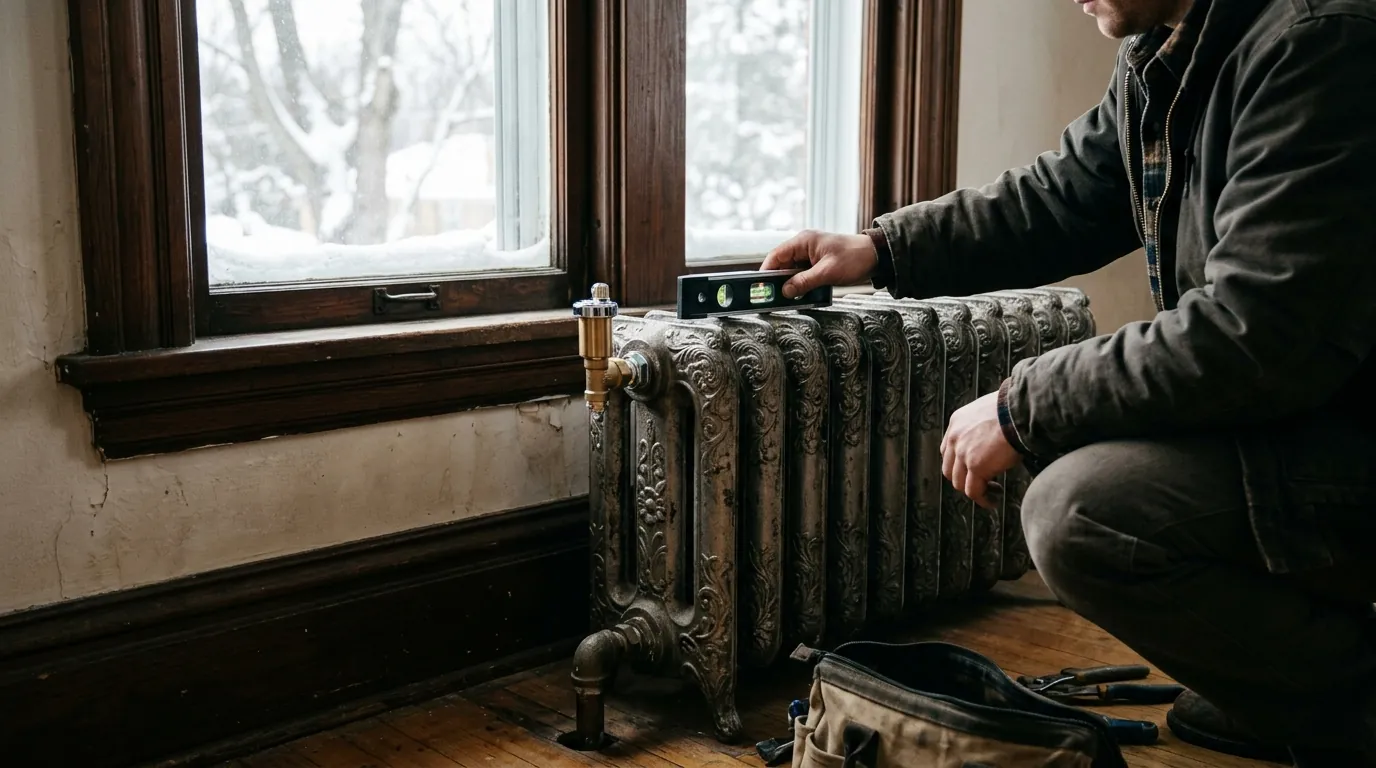
Banging in a steam system is caused by steam slamming into pools of condensate. Over a century, floors settle, joists sag and radiators tip the wrong way. On one-pipe systems, each radiator must tilt slightly toward its supply valve so water drains back. A thin shim under the far legs often stops the noise. The technician uses a level on each noisy radiator and the pipes beneath.
Sagging steam mains in the basement can hold water too, along with undersized pipes added in later renovations. A partly closed radiator valve on a one-pipe system is another cause, since these valves must be fully open or fully closed. High boiler pressure makes banging worse, so the pressure control is checked and set to the low pressure residential steam systems are designed for.
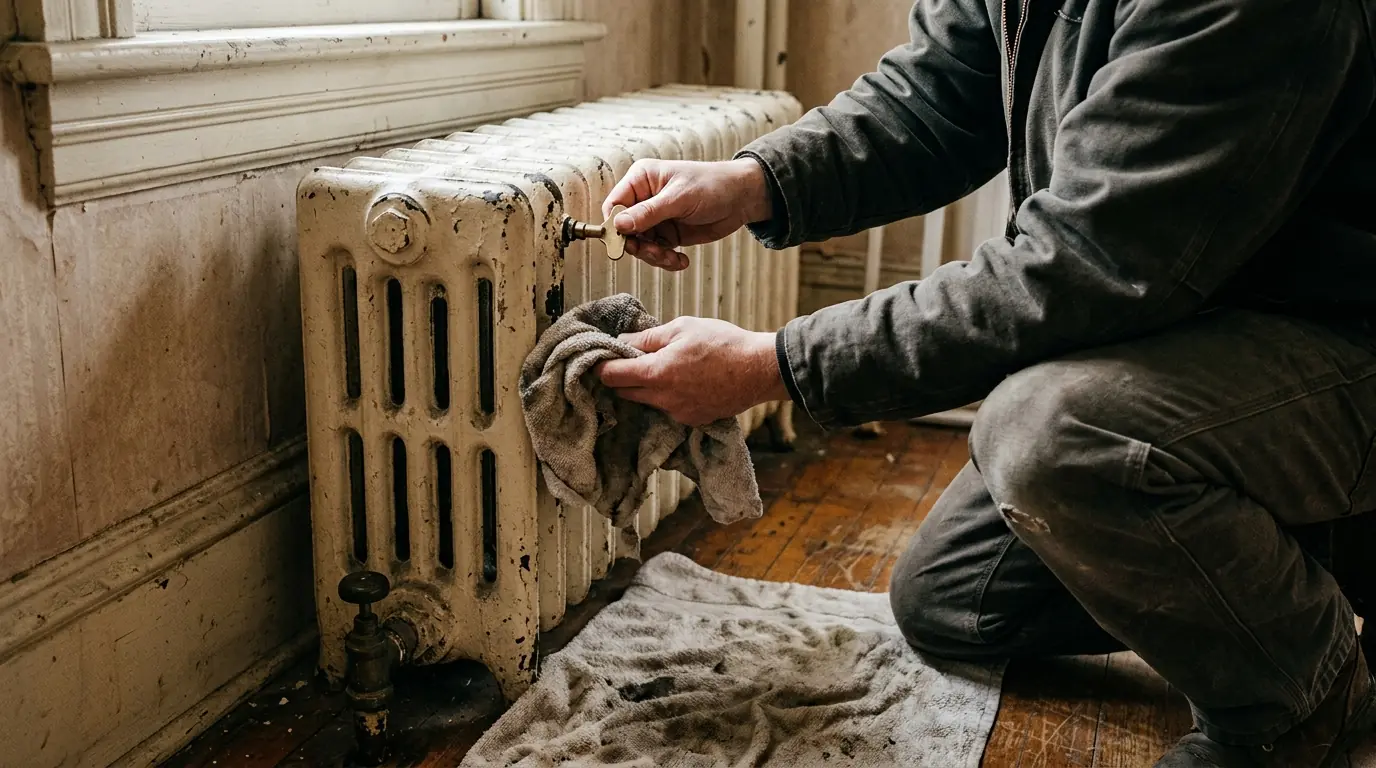
Hot-water radiators look similar to steam radiators but work differently. The system stays full of water under pressure, and a circulator pump moves it through the radiators. The most common complaint is air trapped at the top of radiators, which leaves them cold above a line. Bleeding each radiator from the lowest floor up, then checking boiler pressure, usually fixes it.
Persistent air can mean a problem elsewhere: a failing automatic air vent at the boiler, a missing air separator or a small leak drawing air in. Our technicians also check for sludge buildup in older systems, which slows flow to radiators at the end of a run. Flushing the system and adding a separator can restore heat. For problems at the boiler itself, see boiler repair.
Radiator valves often leak at the stem after decades. The technician repacks the stem or replaces the valve, matching the pipe size and style. On two-pipe steam systems, each radiator has a steam trap on the outlet side that lets condensate pass while blocking steam. Failed traps let steam into the return lines, which causes banging and uneven heat through the whole system.
Some homeowners want thermostatic radiator valves to control individual rooms, which work well on hot-water systems and on some steam setups with the right vents. Others are moving a radiator during a remodel or adding heat to a room the system never reached. For new spaces, a radiant floor heating loop or a short baseboard run off the boiler can match the feel of radiator heat.
| Work | Typical range |
|---|---|
| Steam or hot-water system service visit | $139 to $264 |
| Radiator air vent replacement, each | $38 to $86 |
| Main vent replacement on a steam main | $147 to $318 |
| Radiator valve repack or replacement | $118 to $394 |
| Steam trap replacement, two-pipe system | $164 to $357 |
Typical ranges for older Kalamazoo-area homes. The final price depends on how many radiators and vents need work, and the technician confirms it after surveying the system. Compare more jobs in the furnace and AC price guide.
Keep reading
Repair for hot-water and steam boilers: circulators, pressure problems, leaks, ignition faults and cold radiators.
Learn moreBoiler replacement sized to your radiators and baseboard, from cast-iron steam boilers to wall-hung condensing units.
Learn moreTwo visits a year, furnace in fall and AC in spring, with priority scheduling when your home needs a repair.
Learn moreFAQ
Steam reaches radiators in the order air leaves them. Radiators near the boiler with large vents vent fast and heat first. Far radiators with small or clogged vents heat last. Replacing main vents and sizing radiator vents by distance from the boiler evens this out, so the whole house heats closer to the same time.
Not on a one-pipe system. These valves must be fully open or fully closed, because a partly closed valve traps condensate in the radiator and causes banging and spitting. To lower heat in a room, use a smaller radiator vent or a thermostatic vent made for one-pipe steam instead of the valve.
Look for a small vent on the side of the radiator near the top, often shaped like a bullet. That points to one-pipe steam. Hot-water radiators usually have two pipes and a small square bleed valve near the top. In the basement, a steam boiler has a sight glass and a hot-water boiler has a pressure gauge.
Sometimes, but not always. Conversion means checking every radiator for suitability, often replacing pipes and adding a circulator and expansion tank. Many steam systems heat well once vents, pitch and pressure are corrected, at much lower cost. The technician can compare both paths based on the condition of your piping and radiators.
Residential steam systems are designed for very low pressure, typically under 2 psi, and many run well at less than 1. Higher pressure does not deliver more heat and often makes banging and uneven heat worse. The technician checks the pressure control and, if needed, adds a low-pressure gauge to read it accurately.
Call any hour. Our office answers, sets the visit and tells you what to expect before a technician arrives.