Pilot will not stay lit
If the pilot goes out when you release the knob, the thermocouple is weak or the pilot flame is not reaching it.
The gas fireplace clicks but the pilot will not stay lit, the glass is clouded white, or the flames burn tall and orange instead of steady.
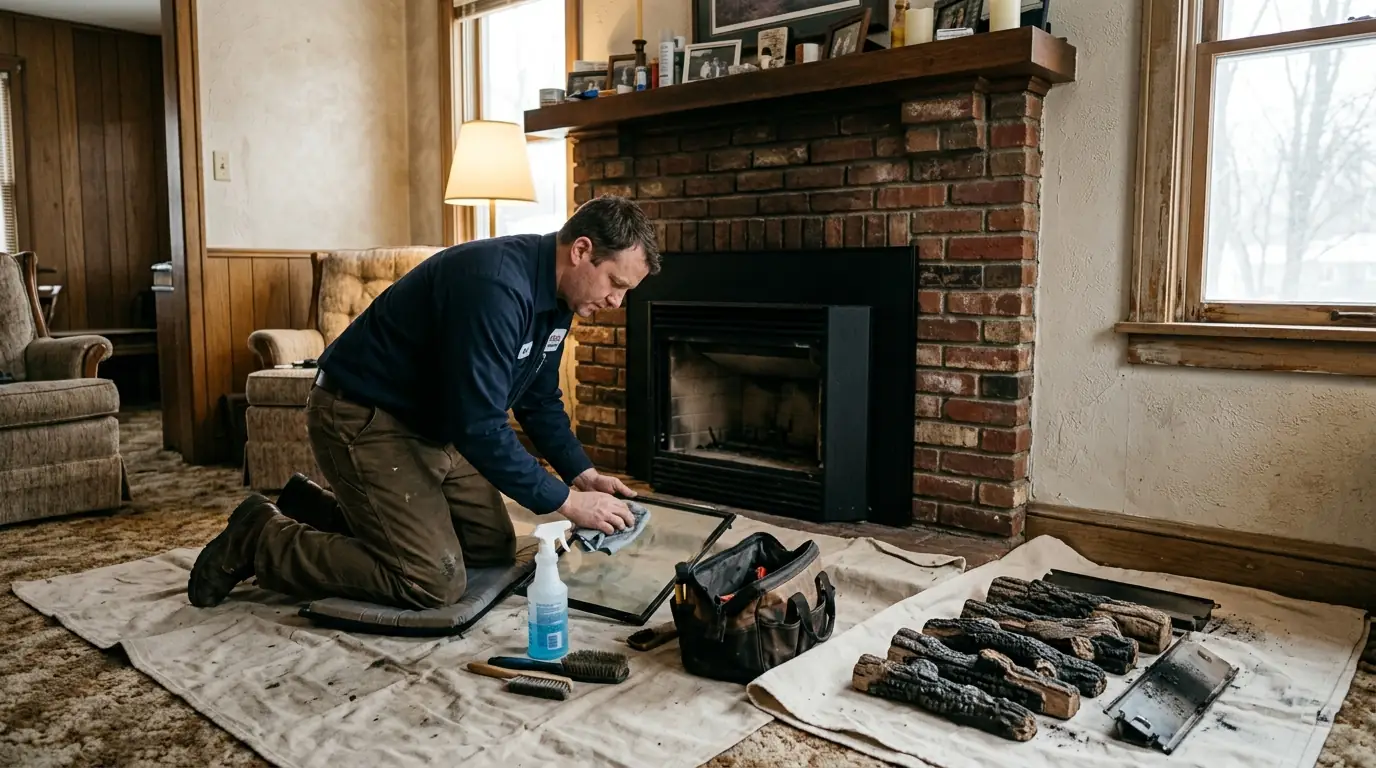
Annual gas fireplace service includes cleaning the pilot assembly and burner, testing the thermocouple or thermopile, inspecting log placement, cleaning the glass, checking the gasket and venting and leak testing the gas valve. Typical cost in the Kalamazoo area is $139 to $229. Common repairs such as a new thermocouple or igniter often add $96 to $284.
Gas fireplaces and inserts have become a common way to warm a living room in Southwest Michigan, from new builds with direct-vent units to older homes where a wood-burning hearth was converted to gas. They are simple appliances, but they sit idle for months, and a spider web in a pilot tube or a weak thermocouple is enough to keep one from lighting on the first cold evening.
Our technicians service direct-vent fireplaces, inserts in masonry chimneys and freestanding gas stoves. The visit covers the pilot assembly, the gas valve, the burner and logs, the glass and gasket, and the vent. Every service ends with a leak check and a flame inspection, since a fireplace that burns poorly can leave soot on the walls and add carbon monoxide to the room.
If the pilot goes out when you release the knob, the thermocouple is weak or the pilot flame is not reaching it.
Mineral deposits from combustion bake onto the glass over a season and need a fireplace-specific cleaner.
Logs that shifted, a blocked air shutter or a vent problem can turn the flame orange and sooty.
A pilot that lights but no main flame can point to a weak thermopile, a bad wall switch or remote, or a valve fault.
A brief smell on the first run of the season is normal. A strong or lasting odor needs an inspection.
An electronic igniter that clicks without lighting may have a cracked electrode or a dead battery pack.
Most residential gas fireplaces use a standing pilot. When you press and hold the control knob, gas flows to the pilot and a piezo spark lights it. The pilot flame heats a thermocouple, which produces a tiny voltage that holds the gas valve open. A larger thermopile, also heated by the pilot, generates enough voltage to open the main burner valve when you flip the wall switch or press the remote.
Newer units often use intermittent pilot ignition, which lights the pilot only when heat is called for and runs on a battery or a household circuit. The parts fail in predictable ways. Thermocouples and thermopiles weaken with age, pilot orifices clog with dust and insects over summer, and wall switch wiring can corrode. Our technicians test each part with a meter rather than replacing parts by guesswork.
The technician turns off the gas and lets the unit cool, then removes the glass front and the logs. The pilot hood and orifice are cleaned, and the thermocouple and thermopile output is measured in millivolts. The burner ports are cleared, embers or lava rock are refreshed, and the logs are set back in the exact positions shown in the manufacturer's diagram, which keeps flames from hitting the logs and making soot.
The glass is cleaned with a non-abrasive fireplace cleaner and the gasket around it is checked for gaps. Outside, the vent cap is inspected for nests, leaves and ice. The gas valve and connections get a leak check, then the fireplace is lit and run long enough to judge flame color, height and the draft at the vent. Any reading that looks off is explained before the technician leaves.
Direct-vent fireplaces pull combustion air from outside and exhaust through a sealed two-layer pipe, usually through a sidewall. That cap must stay clear, and in towns along the lake shore with heavier lake-effect snow, drifting can block it. Inserts in masonry chimneys rely on a liner running to the top of the chimney, and the technician checks the connection at the insert and the cap where it can be seen.
Ventless gas logs are a different matter. They release combustion products straight into the room and add a lot of moisture, which can cause condensation on windows in a tight Michigan home. If you have ventless logs, the technician will check the oxygen depletion sensor and talk through options. A working carbon monoxide check of the room is a smart step with any gas fireplace.
The most frequent repair is a new thermocouple or thermopile, followed by pilot assemblies, igniter electrodes and wall switch wiring. Remote receivers wear out too, especially battery-powered ones that sat with dead batteries all summer. Gas valves fail less often but do happen on fireplaces past 15 years. Our technicians carry the common universal parts and order brand-specific ones when needed.
Some homeowners want more from the fireplace, such as a blower kit that pushes warm air into the room, or a thermostat-controlled remote that cycles the flame to hold a set temperature. These additions can turn a decorative fireplace into a useful heat source for a cold living room. If the fireplace is the only heat in an addition or sunroom, a ductless mini-split may also be worth considering.
| Work | Typical range |
|---|---|
| Annual gas fireplace service and cleaning | $139 to $229 |
| Thermocouple or thermopile replacement | $96 to $217 |
| Pilot assembly or igniter replacement | $168 to $284 |
| Remote receiver or wall switch repair | $118 to $296 |
| Gas valve replacement | $386 to $742 |
Typical Kalamazoo-area ranges. Brand-specific parts can cost more, and the final price is set after the technician tests the fireplace and identifies the failed part. Compare more jobs in the furnace and AC price guide.
Keep reading
New gas piping for furnaces, ranges, dryers, generators, garage heaters and outdoor grills, sized for load and pressure tested.
Learn moreCombustion and venting tests on your furnace, boiler, water heater and other gas appliances, with CO readings in each room.
Learn moreA fall furnace tune-up that cleans, measures and tests ignition, combustion and airflow before the first hard freeze.
Learn moreFAQ
The thermocouple is not sending enough voltage to hold the gas valve open. Either the thermocouple is worn out, or the pilot flame is too small to heat it properly because the pilot orifice is partly clogged. Cleaning the pilot fixes some cases. Others need a new thermocouple, which is a quick repair.
Use a cleaner made for gas fireplace glass, applied only when the glass is completely cool. Household glass cleaners often contain ammonia, which can etch the ceramic glass when it heats. Heavy buildup that will not come off may be permanent etching. We clean the glass during every annual service.
It is a personal choice. Leaving the standing pilot on uses a small amount of gas but keeps moisture and insects out of the pilot tube. Turning it off saves that gas but makes a spring cleaning before fall more important, since spiders often nest in the pilot assembly during warm months.
A fireplace with a standing pilot and thermopile can usually run without household power, which makes it a useful backup heat source for one or two rooms. It will not replace a furnace for the whole house. Fans and electronic ignition models may not run without power or batteries.
Orange, sooty flames usually mean the logs have shifted and the flame is hitting them, the air shutter is partly closed or the vent is restricted. Each of these causes incomplete burning. Stop using the fireplace until it is checked, since poor combustion can also raise carbon monoxide levels in the room.
Call any hour. Our office answers, sets the visit and tells you what to expect before a technician arrives.