Your rooftop unit is past 15 years
Older RTUs often need major parts like compressors or heat exchangers, and replacement may cost less over the next few years.
Replacing a worn-out rooftop unit, fitting out a new tenant space or heating a shop that never had proper heat all start with getting the size and layout right.
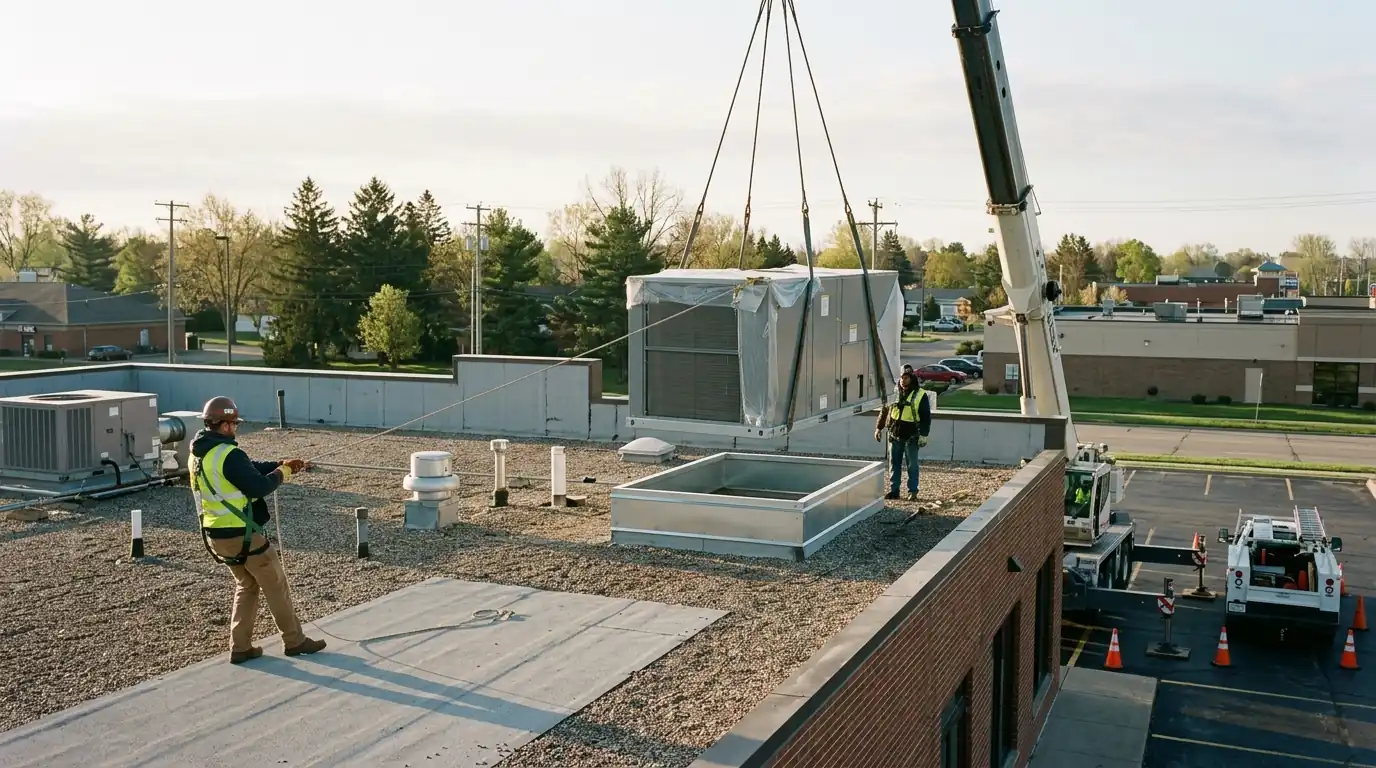
Light commercial HVAC installation covers equipment for small businesses, typically 3 to 25 tons of rooftop or split system capacity, plus unit heaters for shops and warehouses. A proper install starts with a load calculation based on occupancy, lighting, equipment and ventilation needs, then includes curb work, gas and electrical connections, controls and a documented startup.
Light commercial work sits between a house and a large commercial building. Think of a dental office, a coffee shop, a church fellowship hall, a strip center unit or a small fabrication shop. The equipment ranges from a few tons up to around 25 tons per unit, and the job usually involves a roof curb, a crane lift or a long refrigerant line set, plus coordination with the building owner.
Our technicians install packaged rooftop units, commercial split systems, ductless systems, gas unit heaters and radiant tube heaters for businesses across Kalamazoo and Southwest Michigan. We handle the load calculation, equipment selection, crane scheduling, gas piping, controls and startup, and we plan the work so your business can stay open and serving customers for as much of the project as possible.
Older RTUs often need major parts like compressors or heat exchangers, and replacement may cost less over the next few years.
A former retail unit becoming a restaurant or clinic usually needs different capacity, ventilation and zoning.
Adding staff, ovens, lighting or equipment can push the heat load past what the original unit was sized for.
Gas unit heaters or radiant tube heaters can warm a high-ceiling work area where a furnace would struggle.
When the same unit shows up on invoices every few months, it is time to price a replacement alongside the next repair.
Units built for R-22 are expensive to recharge, and a leak can make replacement the practical choice.
Commercial loads are driven by different things than homes. A restaurant kitchen produces enormous heat from cooking equipment, a retail store has heavy lighting and constant door traffic, and a church may go from empty to several hundred people in fifteen minutes. We calculate heating and cooling loads using the building's square footage, insulation, glass, occupancy, lighting, equipment and required outdoor air.
Replacing a rooftop unit with the same tonnage it had before is not always correct. The use of the space may have changed, and many older units were oversized to begin with. An oversized unit short cycles, which leaves the space clammy in summer and wears out compressors faster. Correct sizing usually gives better humidity control and steadier temperatures, along with lower operating costs.
Most rooftop replacements in small commercial buildings follow the same pattern: disconnect and remove the old unit by crane, set the new one on the existing curb or a curb adapter, then reconnect gas, power, controls and the condensate drain. Many swaps are done in a single day when the curb matches. We schedule the crane, coordinate with property managers and plan lifts for early morning to limit traffic and disruption.
Before quoting, we measure the curb, the supply and return openings, and the roof structure around the unit. If the new unit is heavier or larger, we flag it so you can involve a structural engineer or roofer as needed. Gas piping, electrical disconnects and condensate traps are replaced or updated to match the new equipment rather than reused by default.
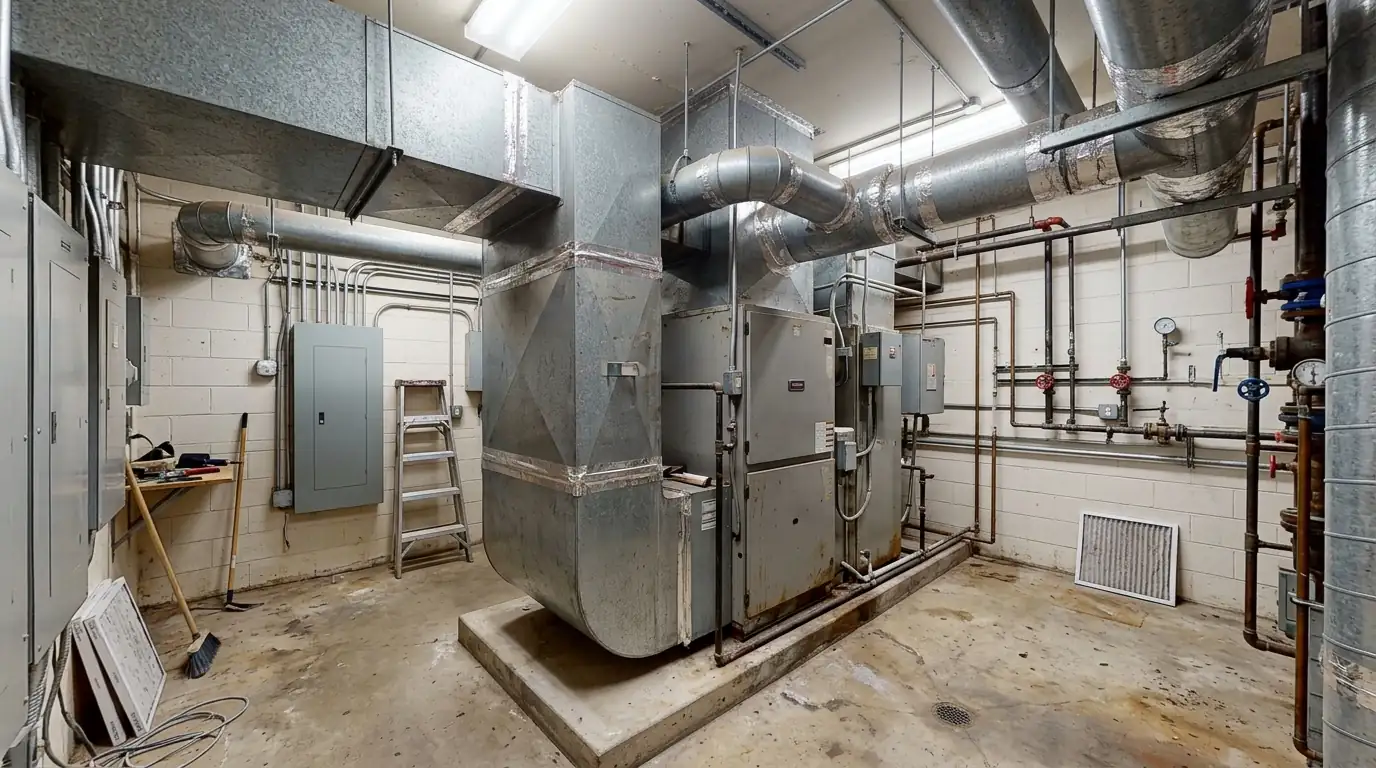
Not every building has a roof that suits packaged equipment. Older downtown buildings, churches and offices often use split systems with an indoor furnace or air handler and an outdoor condenser. We install those with new line sets and properly sized ductwork connections. For server rooms, small additions and spaces without ducts, ductless mini-split systems give dedicated cooling and heating without major construction.
Shops, garages and warehouses are a different challenge. High ceilings and big overhead doors make furnace heat hard to keep near the floor. Gas-fired unit heaters hung near the ceiling, or radiant tube heaters that warm floors and people directly, are usually better choices there. We size them by volume and door openings, and position them to cover work areas rather than empty corners.
A commercial install is not finished when the unit turns on. Our technicians perform a full startup: checking gas pressure and combustion, measuring refrigerant pressures and temperature split, setting economizer minimum positions, confirming airflow and testing every safety control. We record those readings so there is a starting baseline for future service, which makes later problems much easier to diagnose.
Controls get the same care. We set up thermostats with occupied and unoccupied schedules, so the building is not heated or cooled at full output all night and weekend. Before we leave, someone on your staff learns how to adjust the schedule and what the basic alerts mean. New equipment then moves into a seasonal maintenance schedule to protect the manufacturer warranty and the investment.
| Work | Typical range |
|---|---|
| Packaged rooftop unit, 3 to 5 tons, installed | $9,480 to $16,370 |
| Packaged rooftop unit, 7.5 to 12.5 tons, installed | $17,850 to $34,600 |
| Commercial split system, installed | $8,240 to $19,780 |
| Gas unit heater for a shop or garage, installed | $2,960 to $6,140 |
| Crane lift and curb adapter | $1,180 to $4,450 |
These are typical Southwest Michigan ranges for light commercial work. The final price is set after a site visit, and the replacement estimate visit has no charge. Compare more jobs in the furnace and AC price guide.
Keep reading
Repair and seasonal service for packaged rooftop units on stores, offices and restaurants, from belts and coils to gas heat.
Learn moreHeating and cooling repair for restaurants, offices, retail shops, churches and light industrial buildings, at any hour.
Learn moreScheduled spring and fall maintenance for small business HVAC, with unit records, filter schedules and priority repair calls.
Learn moreFAQ
When the new unit fits the existing curb, most single-unit replacements are completed in one day, including the crane lift, connections and startup. Jobs with curb adapters, new gas lines or several units take longer. We plan the lift early in the day so the space is back to normal as soon as possible.
In most cases, yes. Rooftop work happens outside the space, and interior work is usually limited to thermostats and ceiling access. The building is without heating or cooling for several hours during the swap, so we schedule around your slowest time and avoid peak heat or cold when we can.
It depends on the kitchen equipment, dining room size, seating, glass and how much exhaust the hood pulls. Restaurants usually need more cooling and more make-up air than offices of the same size. We calculate the load from those factors rather than using a rule of thumb per square foot.
Gas unit heaters or radiant tube heaters are usually the best fit. Unit heaters recover temperature quickly after a door opens, while radiant tube heaters warm the floor and people directly and lose less heat to the ceiling. The right choice depends on ceiling height, door use and where people work.
Yes. Many older rooftop units and split systems in the area were built for R-22, which is no longer produced and is costly to recharge. Replacing them with current equipment avoids those refrigerant costs and usually brings better efficiency, controls and humidity removal along with it.
Call any hour. Our office answers, sets the visit and tells you what to expect before a technician arrives.