Furnace will not light after a tank refill
Air in the lines after the tank ran low can keep burners from lighting until the system is purged and checked.
Your country home runs on a propane tank, the furnace will not light or keeps locking out, and the closest gas main is miles down the road.
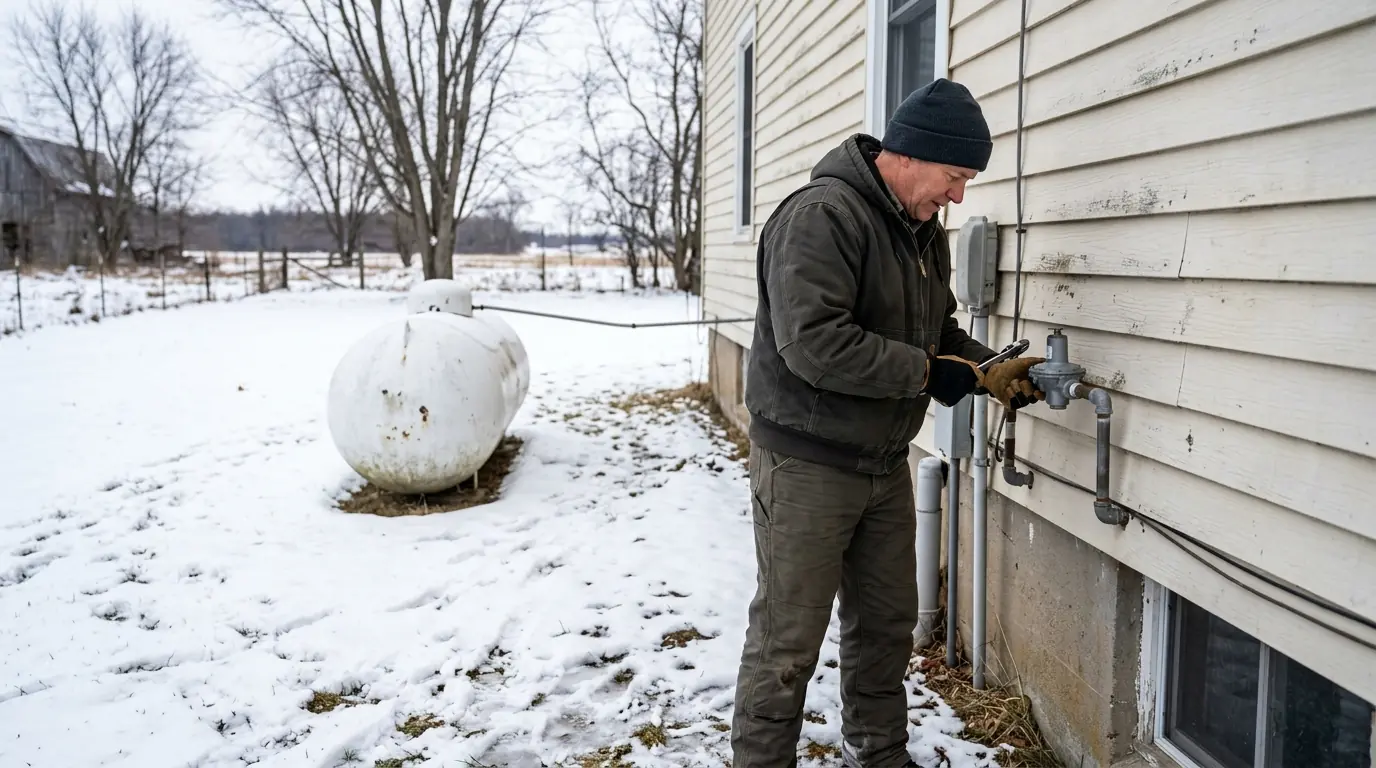
Propane furnace service covers checking LP inlet and manifold pressure, testing the tank and second-stage regulators, leak testing the piping, cleaning burners and orifices and confirming the furnace was correctly converted for propane. In Southwest Michigan, a propane furnace tune-up typically runs $124 to $209. Repairs depend on the part and are priced after diagnosis.
Outside the Consumers Energy gas lines, a lot of homes in Kalamazoo, Van Buren, Cass and Barry counties heat with propane from a tank in the yard. A propane furnace works much like a natural gas furnace, but it runs at a higher gas pressure, uses smaller burner orifices and depends on a tank regulator that sits outside through every Michigan winter. Those differences change how it is serviced.
Our technicians work on propane furnaces every heating season, from farmhouses and lake cottages to newer homes on acreage. We measure LP pressure at the furnace, check the regulator and piping for leaks, and tune the burners for propane's hotter flame. Many of the calls we get after a deep cold snap trace back to the fuel supply rather than the furnace itself, so we look at both.
Air in the lines after the tank ran low can keep burners from lighting until the system is purged and checked.
Propane burners should burn crisp and blue. A soft yellow flame can mean wrong pressure or a dirty orifice.
Propane carries an odorant that smells like rotten eggs. Leave the house and call your propane supplier from outside.
Heavy frost or ice on the regulator body during mild weather can point to a failing regulator or a stuck vent.
A tank that is low or undersized can lose pressure in deep cold, starving the furnace when it needs fuel the most.
Soot often means the furnace is overfired or was not fully converted from natural gas.
Natural gas furnaces typically run with a manifold pressure around 3.5 inches of water column. Propane furnaces run much higher, near 10 inches, and use burner orifices drilled smaller to match propane's higher heat content. Converting a furnace means swapping those orifices and changing the gas valve's regulator spring or setting. If either step is missed, the furnace can overfire, soot up or produce excess carbon monoxide.
The supply side is different too. Propane leaves the tank through a first-stage regulator, travels through underground or surface piping, then drops to appliance pressure at a second-stage regulator near the house. Each regulator has a vent that must stay clear of ice and insects. Our technicians test pressure at the furnace inlet and at the manifold, so they can tell a supply problem from a furnace problem.
The visit begins outside. The technician looks over the second-stage regulator, checks that its vent faces down and is clear, and inspects visible piping for corrosion where it enters the house. Inside, the furnace gets the same burner, flame sensor, igniter and safety switch checks as any gas furnace, plus a close look at the orifices for the spider webs and debris that rural basements tend to collect.
Testing comes next. LP inlet and manifold pressures are measured with the furnace running, the flame is observed for color and stability, and a combustion analyzer confirms clean burning. Piping joints at the furnace are leak tested with an electronic detector or solution. If the furnace label shows it left the factory for natural gas, the technician confirms that a proper conversion kit was installed.
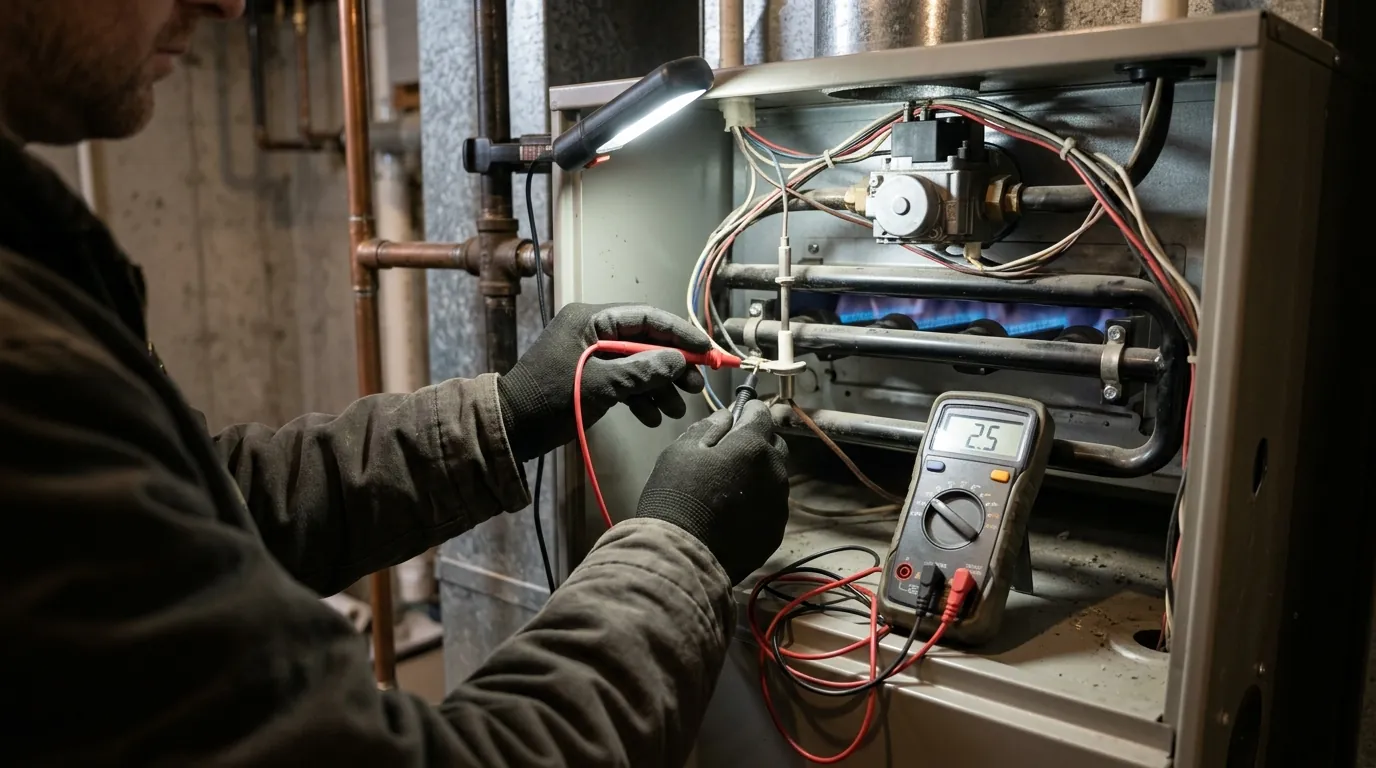
Running a tank dry is one of the most common rural heating emergencies in Michigan. When the tank empties, air can enter the lines and pilot lights go out on other appliances. After a refill, many propane suppliers require a leak check before the system is relit, because an open valve on an unlit appliance could release gas into the house. Call your supplier first, then us if the furnace still will not run.
Once fuel is restored, our technician purges air from the furnace line, relights the system and checks pressure under load. On very cold nights, a nearly empty tank may not vaporize enough propane to keep up with a large furnace, which shows up as weak heat or lockouts. Keeping the tank above about 30 percent through January and February helps avoid that drop.
Propane furnaces share most repair parts with natural gas units: igniters, flame sensors, inducer motors, pressure switches and control boards. The gas valve is the exception, since it must be set up for LP. Our technicians carry propane-ready parts and confirm every replacement valve is configured correctly before startup. A propane furnace on an old 80 percent design may also be a good candidate for an upgrade.
Moving to a high-efficiency propane furnace can make a real difference in fuel use because propane typically costs more per unit of heat than natural gas. Some rural homeowners pair a propane furnace with a heat pump as a dual-fuel system, letting the heat pump carry mild days and the furnace take the coldest nights. For new appliance connections, we also handle gas line installation from the regulator to the furnace.
| Work | Typical range |
|---|---|
| Propane furnace tune-up | $124 to $209 |
| Relight and purge after a tank outage | $139 to $248 |
| Natural gas to LP conversion kit, installed | $186 to $397 |
| LP gas valve replacement | $412 to $768 |
| High-efficiency propane furnace, installed | $4,260 to $7,890 |
These are typical ranges for rural Southwest Michigan homes. Travel distance and the furnace model can affect the final price, which the technician confirms after inspecting the system. Compare more jobs in the furnace and AC price guide.
Keep reading
Gas furnace diagnosis and repair for ignition faults, short cycling, cold air and noisy blowers, any hour.
Learn moreNew gas furnaces sized by room-by-room load calculation, with venting, gas piping and ductwork matched to the house.
Learn moreA heat pump paired with a gas or propane furnace, switching between the two so each runs when it costs the least.
Learn moreFAQ
Most gas furnaces can be converted with a manufacturer kit that includes smaller burner orifices and a regulator spring or setting for the gas valve. The conversion must be done by a technician, and pressures are set and tested afterward. The furnace label is then marked for LP so the next technician knows it was converted.
Propane turns from liquid to vapor inside the tank, and that process slows in deep cold. A tank that is small or low on fuel may not produce enough vapor to supply a large furnace running nonstop. Keeping the tank fuller in winter, or using a larger tank, often fixes the problem without any furnace repair.
Mostly the same, with a few additions. The technician checks LP pressure, which runs higher than natural gas, inspects the second-stage regulator outside and looks closely at the smaller orifices for blockages. Because propane is heavier than air, any leak can pool low in a basement, so connections get a careful leak test.
Call your propane supplier first to refill the tank and complete any leak check they require. Once fuel is back and the system has been checked, call us if the furnace still will not light. Air in the line, a tripped safety switch or a pilot that needs relighting are the usual reasons.
No, a standard CO alarm detects carbon monoxide from any fuel. Some homeowners add a separate propane gas detector mounted low on the wall, since propane sinks rather than rising. That device warns of a fuel leak, while the CO alarm warns of combustion problems. Both are useful in a rural home with an LP furnace.
Call any hour. Our office answers, sets the visit and tells you what to expect before a technician arrives.