Condensation on winter windows
Water running down the glass on cold mornings means indoor humidity is higher than the window surface can handle. Left alone it can stain sills and feed mold growth.
Stuffy rooms, dust that comes back a day after cleaning, or window glass dripping in January usually point to something measurable in the air and the system moving it.
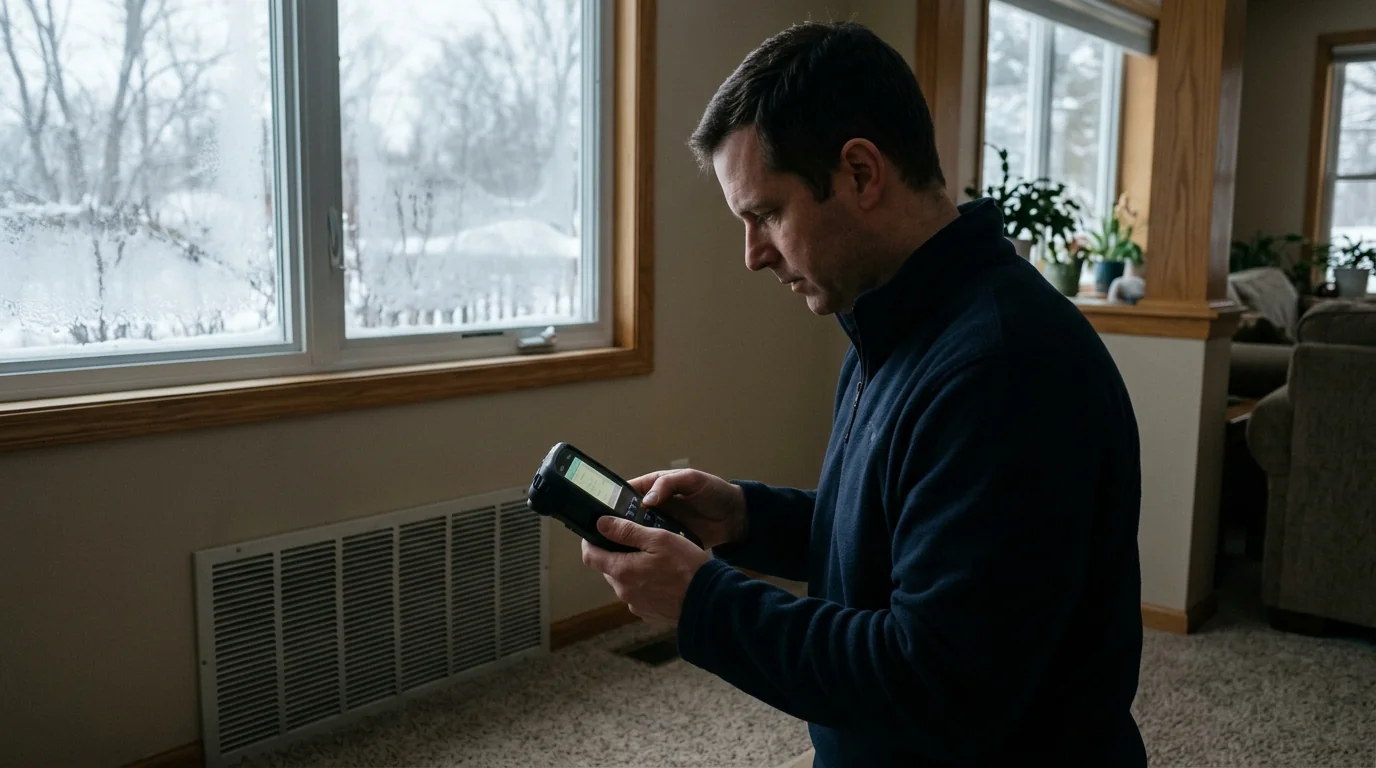
Indoor air quality testing measures relative humidity, airborne particle counts, carbon dioxide, total volatile organic compounds and carbon monoxide in several rooms of your home. A technician compares those readings with outdoor air, checks the furnace filter, return ducts and ventilation, then explains what is driving any high numbers and what would correct them.
Most air complaints in a house start as a feeling: a bedroom that seems close at night, a musty basement smell, a dry throat every February. Testing turns that feeling into numbers. Our technicians bring calibrated meters into your home, take readings room by room, and look at how your furnace or air handler, ductwork and ventilation are moving air through the space.
The goal is practical. A reading by itself means little unless it points to a cause you can fix, such as a return duct pulling from a dusty crawlspace, a humidifier set too high, or a tight house with no fresh air path. We explain each number in plain terms and tell you which changes are worth the money and which ones are not.
Water running down the glass on cold mornings means indoor humidity is higher than the window surface can handle. Left alone it can stain sills and feed mold growth.
Very dry winter air shows up as shocks from door handles, gaps opening in hardwood floors and trim pulling apart. Readings tell us how low the humidity actually drops.
If surfaces are dusty again a day or two after cleaning, the system may be pulling unfiltered air through leaky returns or a filter that does not seal in its slot.
Cooking smells that hang around, a musty basement or a chemical smell after new flooring or paint can point to poor air exchange in the house.
Closed bedrooms with two people sleeping can build up carbon dioxide by morning, especially in newer, tightly built homes with little fresh air coming in.
New cabinets, adhesives, finishes and spray foam can release VOCs for weeks, and an addition can change how air moves through the whole duct system.
Relative humidity is usually the first number we look at, because it drives so many other problems. In a Kalamazoo winter a house without humidification can drop into the teens, while summer basements often sit well above 60 percent. We also count airborne particles in two size ranges, measure carbon dioxide as a stand-in for how much fresh air the house is getting, and log total VOCs from finishes, cleaners and stored products.
Carbon monoxide gets checked at the furnace, water heater and living areas on every visit. Each reading is taken indoors and outdoors so we can see whether a number comes from inside the home or simply reflects the air outside. That comparison keeps the results honest and stops anyone from chasing a problem that is not really there, like a particle spike on a smoky summer day.
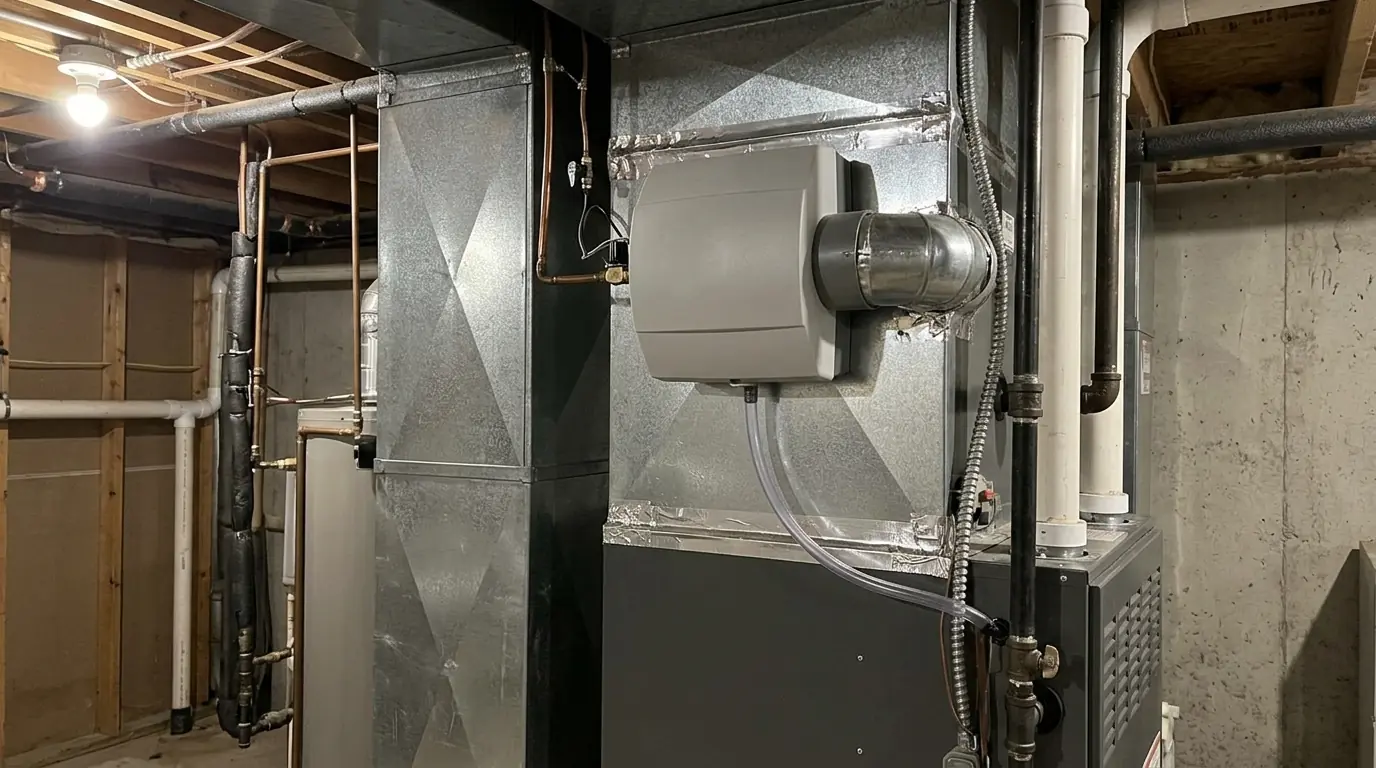
Your forced-air system moves the entire volume of air in the house several times an hour while the blower runs, so it plays a big part in what you breathe. A one-inch filter that leaves gaps around its edges lets dust slip right past. Return ducts with open seams in a basement or crawlspace pull in damp, dusty air and spread it to every register upstairs.
During the visit we look at the filter rack, blower compartment, accessible duct joints and the condition of the evaporator coil if we can reach it. A dirty coil or a damp drain pan can add moisture and musty odors. These are mechanical findings, and they often explain readings far better than any single meter number. We note blower speed and run time too, since a fan that rarely runs moves very little air through the filter.
Southwest Michigan has both extremes. Early 1900s homes around Kalamazoo often leak enough air through old windows, attic floors and balloon-frame walls that winter humidity collapses and the furnace runs long cycles. In those houses the fix is usually humidification, sealing and better filtration, not added ventilation. Basements with fieldstone or block walls can also feed damp air into the furnace return all summer, which shows up clearly in the humidity log.
Newer subdivisions in Portage, Oshtemo and Texas Township are built much tighter. That saves energy, but moisture, carbon dioxide and VOCs have fewer ways out. Testing in a tight home often points toward balanced mechanical ventilation such as an ERV or HRV rather than more filters. The same meter readings lead to very different answers depending on how the house was built.
After testing, our technician walks you through the numbers and ranks the fixes by impact. Some are small: a better filter cabinet, sealing a return, adjusting a humidifier setting or running the blower on a low circulate speed. Others are larger equipment additions, such as a whole-home dehumidifier for a damp lower level or a fresh air system for a tight house.
At the end of the visit you get a written summary of the readings and the recommended changes, with prices for anything that involves equipment. There is no pressure to do everything at once. Many homeowners start with the low-cost items, such as filter fit and return sealing, then retest a season later to see how much the numbers moved before deciding on anything bigger.
| Work | Typical range |
|---|---|
| Standard air quality test (humidity, particles, CO2, VOCs, CO) | $149 to $287 |
| Added rooms or a finished basement | $38 to $76 |
| Multi-day humidity and CO2 logging | $119 to $214 |
| Follow-up retest after changes | $89 to $163 |
| Media filter cabinet upgrade | $318 to $694 |
Testing visits in this part of the state usually fall inside these figures. The final price is set after the technician sees your home and system. Compare more jobs in the furnace and AC price guide.
Keep reading
Negative-pressure duct cleaning with rotary brushes, plus blower and coil checks, for homes with debris built up in the ducts.
Learn moreBypass, fan-powered and steam humidifiers mounted on your furnace, with outdoor-reset controls that keep winter windows dry.
Learn moreMedia filter cabinets, in-duct air cleaners and coil UV lamps fitted to your furnace so cleaner air moves through every room.
Learn moreFAQ
Most homes do well between about 30 and 40 percent in the coldest months. Higher than that and older single-pane or aluminum-frame windows start sweating when nights drop below zero. We often suggest setting the target a little lower during the deepest cold snaps, then raising it as outdoor temperatures climb back up.
No. Radon needs its own test kit or a continuous monitor left in the lowest lived-in level for several days. Our visit focuses on humidity, particles, carbon dioxide, VOCs and carbon monoxide, which are the readings most closely tied to how your heating and cooling equipment operates.
Yes, and it is better if you do, since normal activity gives realistic readings. We ask that you avoid running candles, spray cleaners or the fireplace for a few hours beforehand so the numbers reflect everyday conditions rather than a short spike from one source.
Most homes only need a retest after a change, such as new equipment, a remodel, sealing work or a new baby in the house. Retesting a season after improvements shows whether humidity and carbon dioxide moved the way we expected. Routine yearly testing is rarely needed unless a specific concern keeps coming back.
Sometimes, but not always. A dense filter in a rack with gaps lets air bypass it, and an undersized return can choke the blower when a thicker filter goes in. We check the filter slot fit and the return size before recommending a filter upgrade or a dedicated media cabinet.
Call any hour. Our office answers, sets the visit and tells you what to expect before a technician arrives.