Cold basement slab
Michigan basement floors stay cold all winter. Radiant tubing in a new slab or overlay makes the space livable.
The basement slab is ice cold all winter, the bathroom tile is painful in the morning, or an existing floor heating zone has stopped warming.
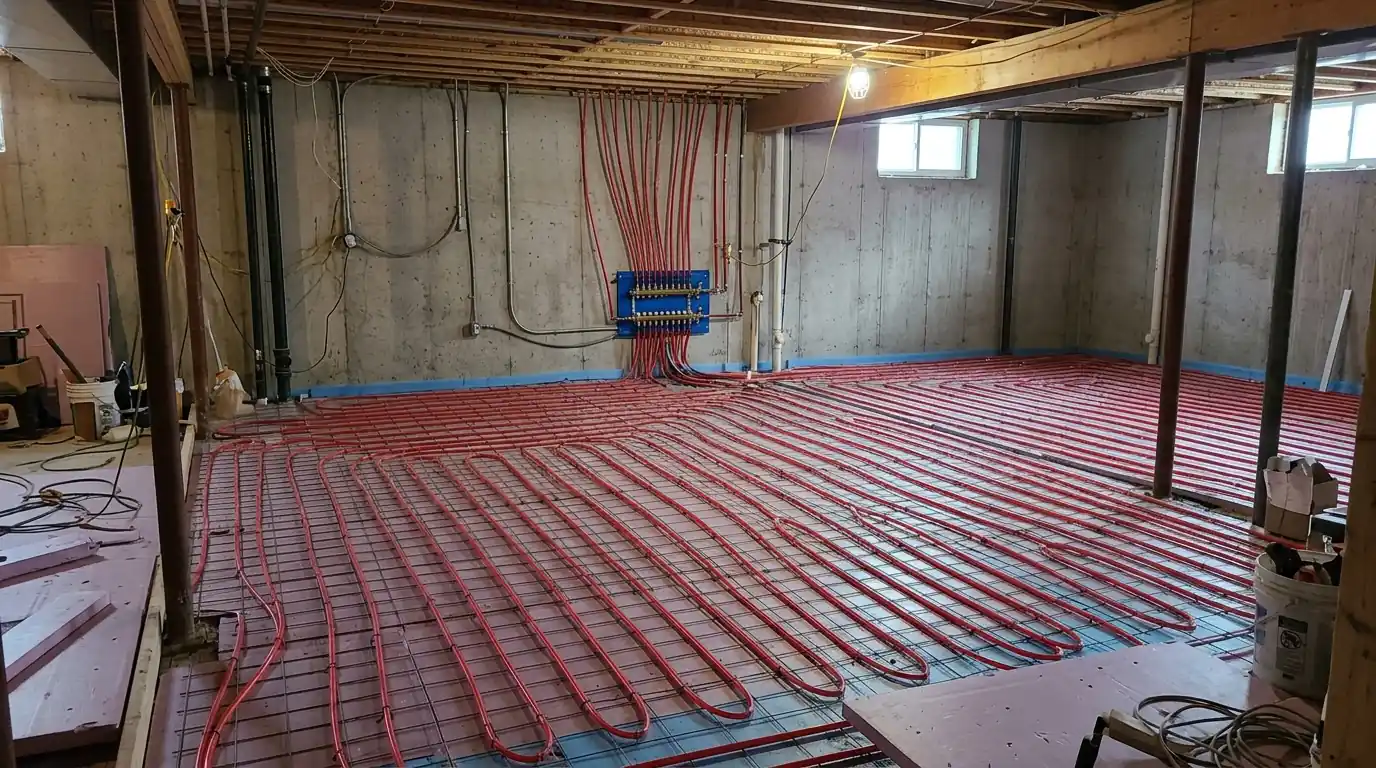
Hydronic radiant floor heating runs warm water through PEX tubing set in concrete, in a thin pour over the subfloor or in panels under the floor. A boiler and mixing valve supply water at about 85 to 120 degrees. In the Kalamazoo area, installed systems typically cost $9 to $21 per square foot, depending on floor type and the heat source.
Radiant floor heating warms the floor itself, which then warms the people and objects in the room. In a Southwest Michigan winter, that changes how a space feels. A basement slab that sat at 55 degrees becomes comfortable to walk on barefoot, and a tiled bathroom stops feeling like a walk-in cooler on a January morning. Heat rises gently from the floor, with no blowing air or noise.
Our installers design and install hydronic radiant systems, which circulate warm water through PEX tubing in the floor, fed by a boiler or a dedicated water heater. We also repair existing systems: failed circulators, mixing valves, manifolds, air in the loops and control problems. Each project starts with a heat loss calculation for the space so tube spacing and water temperature match what the room needs.
Michigan basement floors stay cold all winter. Radiant tubing in a new slab or overlay makes the space livable.
Tile and stone feel coldest. A small radiant zone under the floor fixes it.
In an existing system, a single cold zone often points to a failed zone valve, circulator or trapped air in the loop.
Water temperature may be set too low, or the mixing valve may be stuck. The control settings need a check.
A large boiler serving small radiant zones can cycle constantly without proper piping or a buffer tank.
Additions, garages converted to rooms and new basements are good candidates for radiant heat from the start.
A heat source, usually a boiler, heats water. A mixing valve blends that water down to a safe floor temperature, often between 85 and 120 degrees depending on the floor covering. A circulator pump pushes the water through a manifold, which splits it into individual loops of PEX tubing in the floor. The water gives off heat as it flows and returns cooler to the boiler.
Because the water runs cool, radiant floors pair well with condensing boilers, which are most efficient at low return temperatures. Each room or area can have its own loop and thermostat, with actuators on the manifold opening and closing loops as needed. Floor sensors protect wood floors from overheating. The system responds slowly, so it works best on steady settings rather than large setbacks.
In a new basement slab or a garage floor, tubing is tied to wire mesh over rigid foam insulation, then concrete is poured over it. This method holds heat well and costs the least per square foot. Insulation under the slab matters a great deal in Michigan, since cold ground pulls heat down instead of up into the room. The installer plans the foam with the concrete contractor.
For existing floors, there are two main options. A thin pour of lightweight concrete or gypsum over the subfloor adds about an inch and a half of height and works well under tile. Aluminum heat transfer plates under the subfloor, installed from the basement, leave the finished floor untouched. Grooved panels on top of the subfloor are another choice for remodels where floor height is limited.
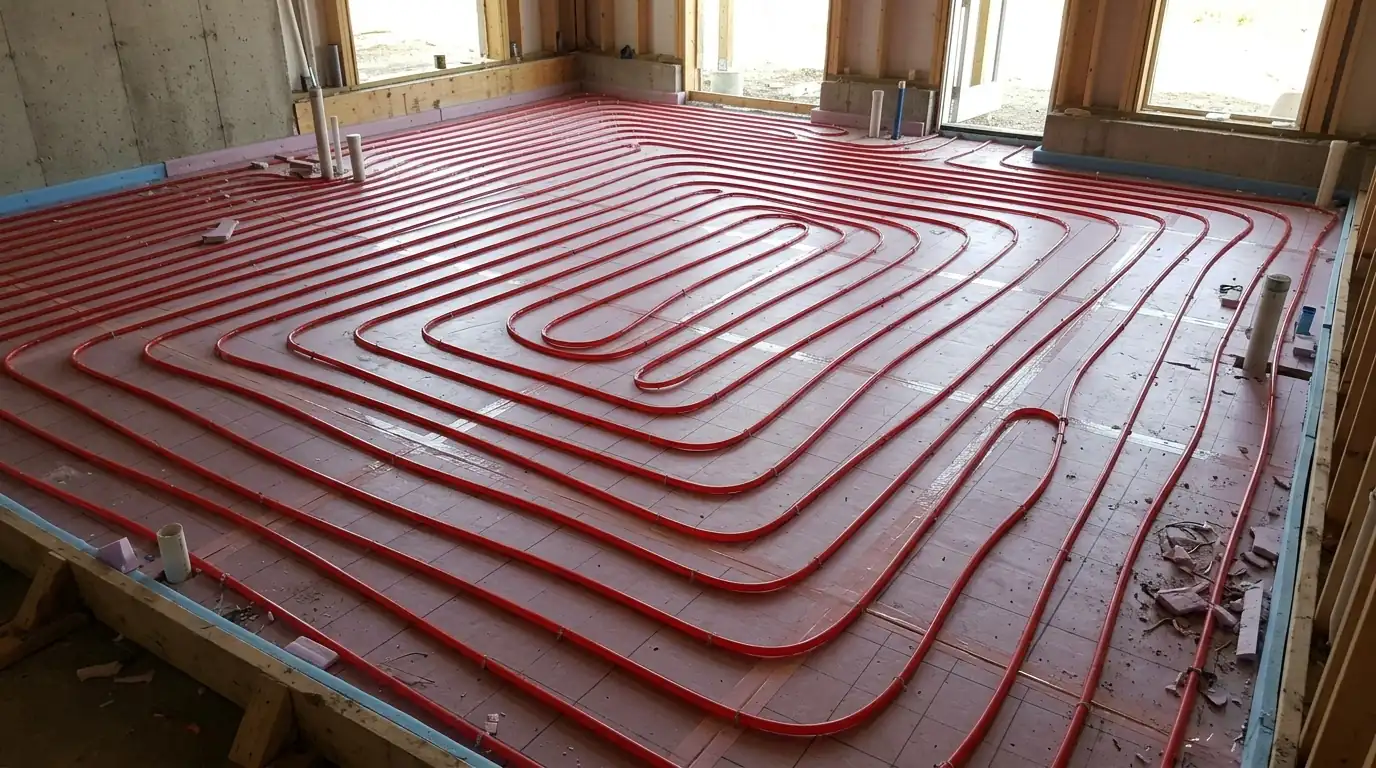
Whole-house radiant systems usually run on a dedicated boiler, often a condensing modulating unit. For a single bathroom or a basement zone, the system can be added to an existing hot-water boiler with a mixing valve and its own circulator. In homes heated with a furnace, a high-efficiency water heater or a small wall-hung boiler can supply a radiant zone without replacing the main system.
Controls range from simple thermostats on each zone to outdoor reset controls that adjust water temperature to the weather, which keeps floors from overheating on mild days. In older Kalamazoo homes with radiator heat, a radiant zone can share the boiler with existing radiators if the piping keeps the two water temperatures separate. The installer can look at how it ties in with a new boiler if one is planned.
Radiant tubing in the floor rarely fails. When an older system stops heating, the cause is almost always above the floor: a failed circulator, a stuck mixing valve, a dead zone valve actuator, air in the loops or a boiler issue. The technician measures supply and return temperatures at the manifold to see which loops are flowing, then traces the problem from there.
Older systems from the 1980s and 1990s sometimes used tubing without an oxygen barrier, which lets oxygen into the water and corrodes iron parts in the boiler and pumps. The fix is usually a heat exchanger that separates the floor loops from the boiler. If the room still feels cold, the technician also checks insulation and floor coverings, since thick carpet over radiant tubing cuts heat output noticeably.
| Work | Typical range |
|---|---|
| In-slab radiant tubing, per square foot | $9 to $14 |
| Under-subfloor plates or thin pour, per square foot | $13 to $21 |
| Bathroom radiant zone added to existing boiler | $2,370 to $4,860 |
| Manifold, mixing valve or circulator repair | $298 to $1,140 |
Typical Southwest Michigan ranges. Boiler costs are separate when a new heat source is needed, and the final price is set after the installer sees the space and the existing system. Compare more jobs in the furnace and AC price guide.
Keep reading
Boiler replacement sized to your radiators and baseboard, from cast-iron steam boilers to wall-hung condensing units.
Learn moreRepair for hot-water and steam boilers: circulators, pressure problems, leaks, ignition faults and cold radiators.
Learn moreGas and propane tankless water heaters sized for Michigan's cold inlet water, with new venting and gas piping as needed.
Learn moreFAQ
Often, yes. If the basement ceiling is open, aluminum heat transfer plates and PEX tubing can be installed from below, leaving the finished floor in place. A floor temperature sensor protects the wood from overheating. Some engineered wood floors handle radiant heat better than solid boards, so the installer checks the flooring first.
A radiant floor in a concrete slab can take several hours to come up to temperature, while thin-pour and plate systems respond faster. Because of this, radiant floors work best on steady thermostat settings. Large nightly setbacks are usually not worth it, since the floor takes too long to recover in the morning.
Yes. Without rigid foam under the slab, much of the heat flows down into the cold ground instead of up into the room. In Michigan, insulating under the slab and at its edges makes a large difference in comfort and fuel use. For existing slabs, an insulated overlay can be installed on top.
Some small zones can run from a water heater rated for space heating, usually with a heat exchanger to keep the floor loop separate from drinking water. A standard tank water heater is not meant for long heating loads. The installer checks the unit's specifications and the zone size before recommending this approach.
A single cold loop usually means no water is flowing through it. Common causes are a failed actuator on the manifold, a closed balancing valve or air trapped in that loop. The technician measures the loop's temperature at the manifold, then purges air or replaces the actuator to restore flow.
Call any hour. Our office answers, sets the visit and tells you what to expect before a technician arrives.