Start by measuring what the AC is doing
Before changing anything, take two quick readings. Hold a kitchen thermometer in the return grille for a minute, then hold it in a supply register close to the indoor unit. A healthy central air system usually cools the air by roughly 15 to 20 degrees between those two points once it has been running for 15 minutes or so.
If the difference is near that range but the house still feels warm, the system may be working and simply losing ground on a very hot, humid day, or the house may be gaining heat faster than the unit can remove it. If the air from the vents is barely cooler than the room, something is wrong with the system itself.
Also note whether the outdoor unit is running. Walk outside and listen. You should hear the compressor hum and see the top fan spinning and blowing warm air upward. A silent outdoor unit while the indoor blower runs is an important clue. Write down what you find, along with the time of day and the outdoor temperature, so the technician has a clear picture if you end up calling.
Thermostat and power checks
Confirm the thermostat is set to COOL, the set point is several degrees below room temperature, and the fan is on AUTO. A fan left on ON will keep pushing air between cooling cycles, and that air can feel warm and humid, especially after the coil has stopped cooling.
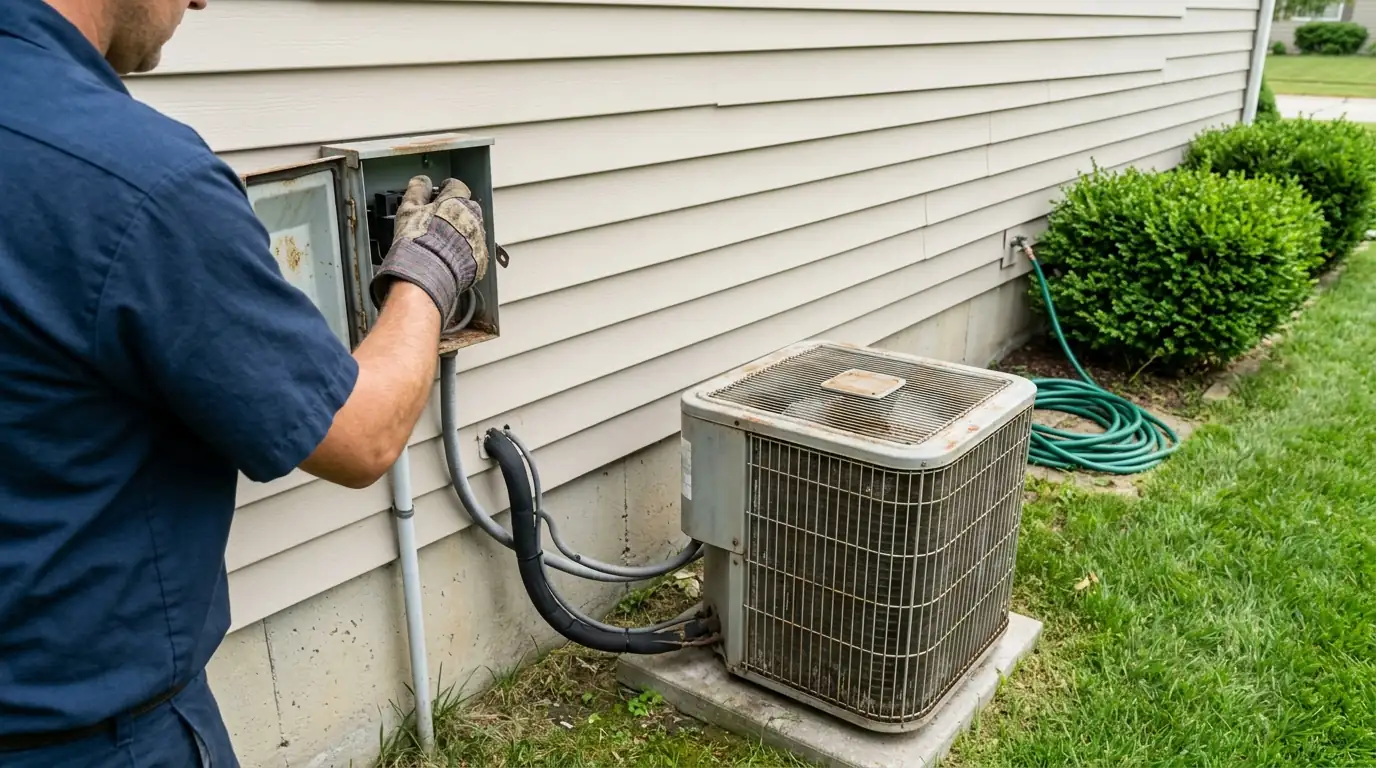
Check the breaker panel for a tripped breaker on the air conditioner circuit. The outdoor unit also has a disconnect box mounted on the house wall nearby, usually with a pull-out block or a lever. Make sure it is in the ON position, and if a breaker trips again soon after you reset it, leave it off, since a repeat trip points to an electrical fault or a failing compressor, and that needs a technician. Smart thermostats can also be affected by a utility peak-time setting, so check whether the schedule or app shows a temporary hold.
If the thermostat display is blank, replace the batteries. Some thermostats draw power from the system and go dark when a safety switch on the indoor unit opens, which brings us to the drain.
The filter, the coil and the condensate drain
A dirty filter is the leading homeowner-fixable cause of poor cooling. Restricted airflow lets the indoor evaporator coil get too cold, and in humid weather it can freeze solid. A frozen coil stops cooling almost completely. Look at the copper line running to the outdoor unit and at the indoor coil area. If you see frost or ice, turn the system to OFF and the fan to ON for a few hours to thaw it, then replace the filter before turning cooling back on.
Air conditioners also pull a lot of water out of humid Michigan air. That water drains through a plastic line to a floor drain or a small pump. Many systems have a float switch that shuts the AC off when the drain backs up. Check the drain pan under the coil for standing water and listen to see whether the condensate pump runs. If your drain line has a capped access tee near the coil, pouring a cup of white vinegar into it each spring can slow the algae growth that clogs these lines in humid weather.
If the coil freezes again after a fresh filter, or the drain keeps backing up, the cause is deeper, such as low refrigerant, a weak blower or algae in the drain line, and a technician should take it from there.
Check the outdoor unit
The outdoor condenser releases the heat taken out of your house. It needs open space and clean fins to do that. Turn the power off at the disconnect before you touch anything near the unit. Then look for the problems in the list below, which a homeowner can usually fix with a garden hose and a pair of gloves.
Do not open the top grille, touch the electrical panel, or attempt to straighten fins with a screwdriver. The panel on the side of the unit holds capacitors that can store a dangerous charge even with the power off. Once the coil is rinsed and the area is clear, restore power and give the system 15 minutes before you measure again.
- Grass clippings, cottonwood fluff or leaves packed against the fins.
- Shrubs, fencing or stored items closer than about 2 feet to the sides.
- A coil so dirty that you cannot see light through the fins. Rinse gently from the inside outward with a hose on low pressure.
- A unit that has settled and tilted, which can strain the refrigerant lines.
- Signs of a fan that will not spin, burning smells, or a loud buzzing with no fan movement.
Problems that need a technician
Several common causes of poor cooling involve refrigerant or electrical parts, and these must be handled by a technician. A failed run capacitor is one of the most frequent summer repairs: the outdoor unit buzzes or the fan does not spin because the motor cannot start. Contactors, the switch that powers the outdoor unit, also wear out and can stick open or closed. These parts cost far less than the compressor they protect, which is why catching them early matters.
Low refrigerant always means a leak somewhere, since refrigerant is not used up like fuel. Adding refrigerant without finding the leak is a short fix that has to be repeated. A refrigerant leak repair visit locates the leak with electronic detection or bubble testing and repairs it before recharging. Typical repair ranges in our area run about $289 to $1,180 depending on where the leak is and how much refrigerant is needed, set after the technician sees the system.
A compressor that hums but will not start, trips its breaker, or runs very hot may have a failing start component or internal wear. Our AC repair technicians test the compressor, capacitor and wiring with meters before recommending parts.
When the unit works but the house still feels warm
Sometimes the system is fine and the house simply gains heat faster than the AC can remove it. Upstairs bedrooms, rooms over garages and rooms with large west-facing windows heat up quickly on summer afternoons. Closing blinds on the sunny side, sealing attic air leaks and checking attic insulation can make a real difference. Ceiling fans help people feel cooler as well, though they do not lower the room temperature.
Humidity matters too. Kalamazoo summers can be muggy, and an AC that is too large for the house cools the air quickly and shuts off before it removes much moisture. The house reads 72 degrees on the thermostat but feels clammy. Longer, steadier cycles remove more moisture, and some homes benefit from a dehumidifier working with the AC. Lowering the thermostat further will not fix that clammy feeling.
Leaky ducts in an attic or crawlspace can also dump cooled air before it reaches the rooms. If one part of the house is always warm, a technician can check duct leakage and room airflow. For any AC issue past these checks, call (269) 360-5258 at any hour, and a Teed technician will come out to diagnose it. An AC tune-up each spring catches many of these problems before the first heat wave.
Lyman Tibbetts, Comfort Guides Editor at Teed Heating & Cooling. Lyman edits the Comfort Guides with our technicians, turning the questions homeowners ask on service calls into plain answers.