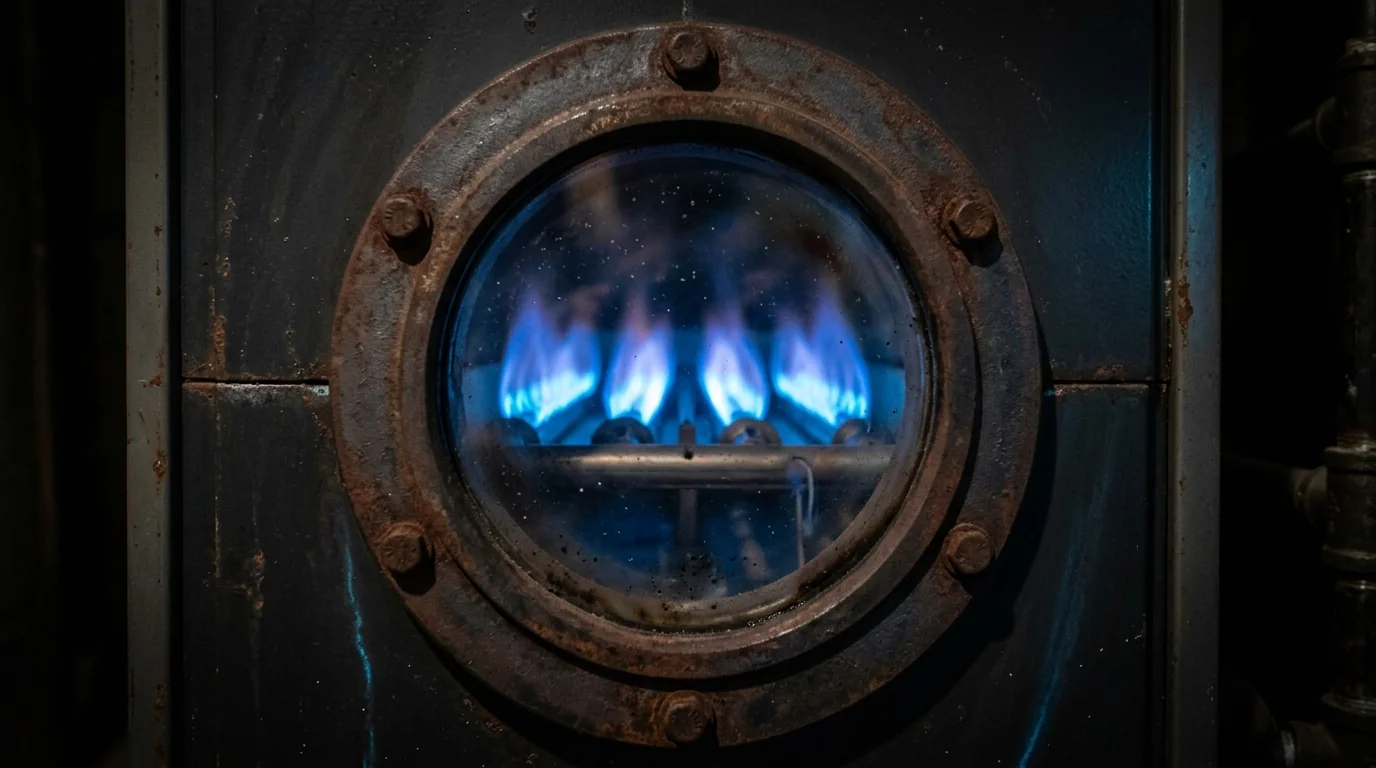
How to look at the flame safely
Many furnaces have a small sight glass or a slotted cover on the burner compartment that lets you see the flames without opening anything. On newer sealed-combustion furnaces, you may need to look through a small window in the inner panel. Never remove the burner cover, hold a lighter near the burners, or put your face close to an open compartment. The view through the glass is enough.
Wait until the furnace has been running for a minute or two before you judge the color. Right at ignition, flames can flicker and show a little yellow while the air and gas mix settles. After the burners stabilize, you are looking at the flame the furnace will hold for the rest of the cycle.
If your furnace has no view at all, that is fine. You can still use the other warning signs in this guide, such as soot, odors and alarm readings, and a technician will check the flame during any service visit.
A steady blue flame is what you want
Natural gas burns cleanest when it mixes with the right amount of air. The result is a crisp blue flame, often with a slightly darker or lighter blue inner cone near the burner opening. The flames should stand evenly across all burners, sit right on the burner ports, and move only a little.
A small tip of yellow or orange at the very top of an otherwise blue flame is common and usually not a concern. Occasional orange flecks that flash and disappear are usually dust particles in the air burning off. You may see more of them when you first turn the heat on in the fall, when dust has settled in the burner area all summer, or when there is drywall work or sanding going on in the house. A quick change of the filter and a vacuum around the outside of the cabinet cuts down on that dust.
Propane flames look much the same when the burner is set up correctly. A propane furnace needs its own orifices and gas valve settings, so a unit converted from natural gas should always show the same clean blue flame.
Yellow or orange flames and what they mean
A flame that is mostly yellow or orange, lazy and soft rather than sharp, points to incomplete combustion. The gas is not getting enough air to burn fully. Incomplete combustion produces more carbon monoxide, and it can leave black soot on the burners, the heat exchanger and the area around the furnace.
The common causes are dirty or rusted burners, spider webs or debris in the burner tubes, a blocked combustion air supply, a gas pressure problem, or a cracked heat exchanger that lets blower air disturb the flame. None of those can be sorted out by looking alone, and none are safe for a homeowner to adjust. Air shutters, gas pressure and orifices should be set by a technician with a manometer and a combustion analyzer. Take a photo through the sight glass if you can, since it helps the technician see what you saw.
Treat a mostly yellow flame as a reason to shut the thermostat down and call for service the same day. If any carbon monoxide symptoms are present in the house, the steps in the next section come first.
When flame color becomes a carbon monoxide warning
A yellow flame by itself does not prove carbon monoxide is in your living space, but it raises the odds. The danger grows when a poor flame shows up alongside other signs. Leave the house, get everyone and pets outside, and call 911 or Consumers Energy from outside if any of these appear:
Once you are outside, do not go back in to open windows or shut off the furnace. Responders will test the air and tell you when it is safe. After that, a technician needs to find the source before the furnace runs again, because the cause could be the furnace, a water heater, a blocked chimney or a car left running in an attached garage. Our carbon monoxide safety check tests the flue, the appliances and the air in the living space.
- Your carbon monoxide alarm is sounding or showing a reading.
- People in the house have headaches, dizziness, nausea or unusual tiredness that ease when they step outside.
- Soot or black streaks around the furnace, the vent connector or the sight glass.
- Heavy condensation on cold windows near the furnace room, paired with a stale or stuffy smell.
- A pilot or burner flame that keeps going out or burns yellow on more than one gas appliance.
Lifting, rolling and dancing flames
Shape matters as much as color. A flame that lifts off the burner ports, leaving a gap between the burner and the base of the flame, often means gas pressure is too high or too much primary air is getting in. A lifting flame can blow itself out and lead to repeated ignition attempts. On older atmospheric furnaces with an open burner area, a flame that wavers in a draft from a nearby door can also lift.
A flame that rolls out of the front of the burner compartment, or curls toward you through the sight glass, is more serious. Rollout usually means the flue gases cannot leave the furnace normally, either because the vent is blocked or the heat exchanger is cracked. Most furnaces have a rollout switch that shuts the gas off, and a tripped rollout switch should never be reset by a homeowner without finding the reason.
Watch what happens when the blower comes on. If the flames jump, bend or change color the moment the fan starts, that is a classic sign that blower air is reaching the burners through an opening in the heat exchanger. Turn the furnace off at the thermostat and schedule a heat exchanger inspection before using it again.
What a technician does about a bad flame
A proper flame check is more than a glance. A technician measures inlet and manifold gas pressure, runs a combustion analyzer in the flue to read carbon monoxide and oxygen, checks the draft, and inspects the burners and heat exchanger with a light and camera where the design allows. That gives hard numbers instead of a judgment based on color alone.
The fix depends on what the readings show. Dirty burners get pulled and cleaned, and clogged orifices get cleared or replaced. Gas pressure gets set to the manufacturer value. A blocked vent gets cleared and the cause corrected. A cracked heat exchanger usually means replacing the heat exchanger or the furnace, and a technician will show you the evidence before talking about either option.
A yearly tune-up catches most of these problems before they show up as a yellow flame. If your flame looks wrong now, call (269) 360-5258 any hour, and a Teed technician will come out to test it.
- Inlet and manifold gas pressure, compared with the data plate on the furnace.
- Flue gas readings for carbon monoxide and oxygen, taken while the furnace runs.
- Draft at the vent connector and the condition of the chimney liner or plastic vent.
- Burner faces, orifices and the flame sensor for rust, soot and debris.
- The heat exchanger surfaces that can be reached with a light or inspection camera.
Lyman Tibbetts, Comfort Guides Editor at Teed Heating & Cooling. Lyman edits the Comfort Guides with our technicians, turning the questions homeowners ask on service calls into plain answers.