What short cycling looks like
A healthy gas furnace in a Michigan winter usually runs in cycles of several minutes or longer, with more frequent and longer runs on the coldest nights. Short cycling is when the furnace fires up, runs only a minute or three, shuts down, and then starts again soon after. Sometimes it never reaches the set temperature. Other times the house gets warm but swings up and down.
Listen and time it. Note when the burners light, when they shut off, and whether the blower keeps running after the flame goes out. A furnace that lights and drops the flame within seconds is a different problem from one that runs two minutes and stops, and that detail points to the cause. A phone timer or a notepad by the thermostat works fine for this, and an hour of notes on a cold evening is usually enough.
Short cycling matters for more than comfort. Every start puts wear on the igniter, inducer motor and control board, and the frequent heating and cooling of the heat exchanger adds stress to the metal. It also wastes fuel, since a furnace is least efficient in the first minutes of each cycle.
A dirty flame sensor
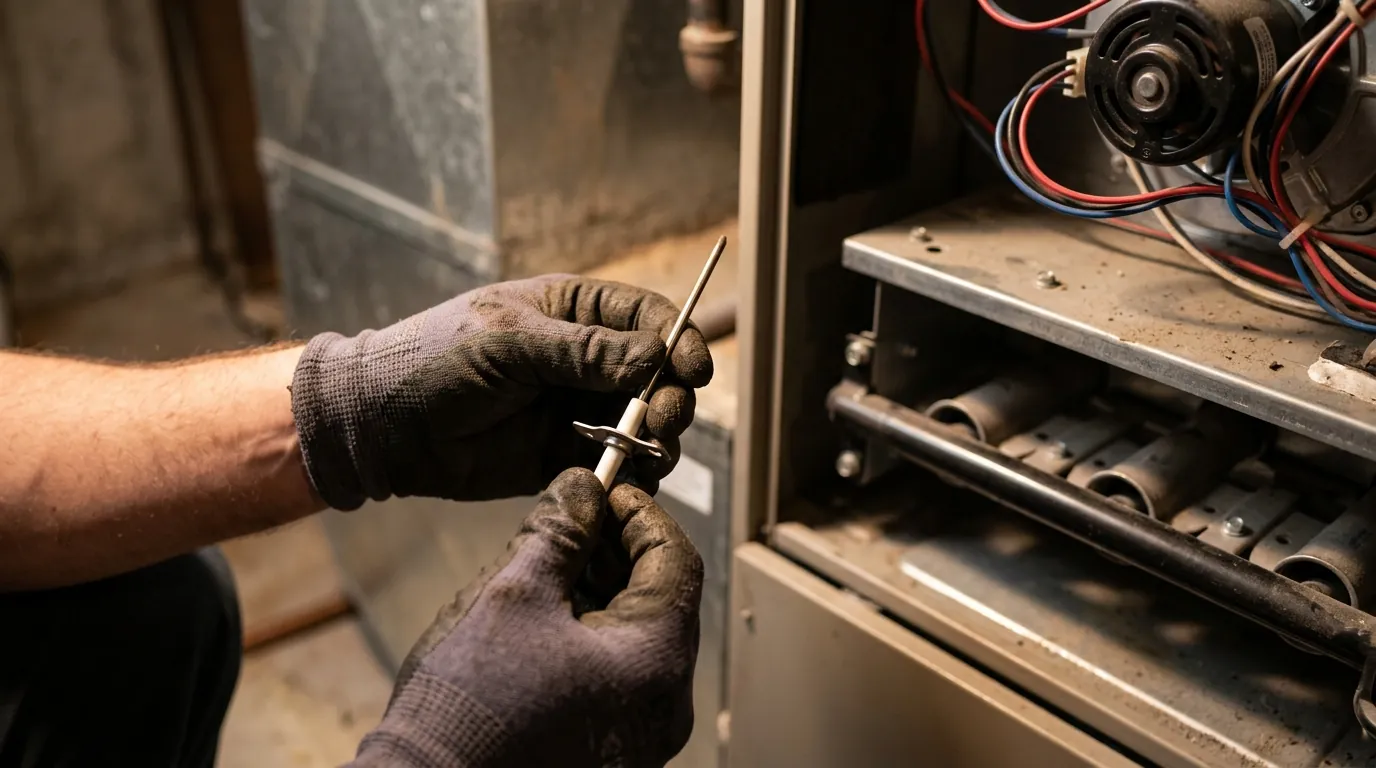
The flame sensor is a short metal rod that sits in the burner flame. It tells the control board that the gas has lit. When it gets coated with a thin layer of residue, the signal weakens, and the board shuts off the gas valve as a safety step. The furnace lights, the flame burns for a few seconds, and then it goes out. After a few tries, the board may lock out completely.
This is one of the most common causes of short cycling in furnaces from the last 25 years or so. The fix is usually a gentle cleaning of the rod, a check of its ground connection and a measurement of the flame signal in microamps. Sometimes the sensor is cracked or the porcelain is damaged, and it needs replacement. Residue builds faster in homes with dusty basements or where household chemicals are stored near the furnace.
Although cleaning a flame sensor is a common task, it involves opening the burner compartment and working next to the gas valve and high voltage igniter. We recommend leaving it to a technician, who can also find out why the sensor fouled in the first place.
Airflow, filters and the limit switch
Every furnace has a high limit switch that shuts off the burners when the heat exchanger gets too hot. Restricted airflow is the usual reason. A clogged filter, closed registers in too many rooms, a dirty blower wheel, a weak blower motor or undersized return ducts all leave heat trapped in the furnace. The limit opens, the burners stop, the blower cools everything down, and the cycle repeats.
This kind of short cycling usually looks like a furnace that runs a few minutes, shuts the flame off while the blower keeps going, then restarts. The house may never quite reach the set temperature, and the air from the vents may feel very hot for a short time before the burners cut out. Leave it running this way for long and the limit switch itself can weaken, so it starts tripping at lower temperatures than it should.
Start with the simple checks below. If they do not solve it, the limit switch may be tripping because of a blower or duct problem. A technician will measure temperature rise across the furnace and static pressure in the ducts to find it.
- Replace the filter, even if it was changed recently.
- Open supply registers in every room, including unused ones.
- Clear furniture and rugs away from return grilles.
- Make sure the blower door is closed and seated.
An oversized furnace
A furnace that is too large for the house heats the air so fast that the thermostat is satisfied in a few minutes, and the burners shut off. Then the house cools quickly and it starts again. This happens often in Kalamazoo homes where insulation, windows or air sealing were improved after the furnace went in, or where a replacement was sized simply by matching the old unit.
Signs of oversizing include short runs even on very cold days, hot and cold swings in rooms, noisy airflow at the registers and rooms far from the furnace that stay cool. Unlike other causes, oversizing shows up from the first day of the furnace and does not go away with a new filter.
Two-stage and modulating furnaces help a lot here, since they can run at a lower output for long, steady cycles. When it is time for a replacement, a proper heat load calculation sizes the new furnace to the house as it is today. A furnace installation estimate from our team starts with that calculation, and the estimate visit has no charge.
Thermostat placement and settings
Sometimes the furnace is fine and the thermostat is giving it bad information. A thermostat mounted too close to a supply register, on a wall that gets afternoon sun, above a lamp or near the kitchen will read warm and shut the furnace off early. One on an outside wall or near a drafty door can call for heat too often. Thermostats on interior walls near the center of the house, about five feet off the floor, usually give the truest reading.
Check the heat anticipator or cycle rate setting too. Older mercury and mechanical thermostats have a small adjustable lever that controls how long the furnace runs, and many digital models have a cycle setting in the installer menu. If the setting does not match the equipment, it can produce short runs. A thermostat set up for a heat pump on a gas furnace system can also behave oddly. Loose thermostat wires at the wall plate can also cause brief drops in the call for heat.
If you suspect the thermostat location, a smart thermostat installation can move the control to a better central wall, or add remote room sensors that average temperatures from several rooms.
Other causes and when to call
A few other problems cause short cycling and all of them belong with a technician. A blocked or iced-up vent pipe on a high-efficiency furnace can trip the pressure switch mid-cycle, and a clogged condensate trap can do the same. A failing inducer motor may not hold the pressure the furnace needs, and a weak or loose wire on the control board can cause random shutdowns. A cracked heat exchanger can trigger a rollout switch. Low gas pressure, which is more common on propane systems as the tank runs low in deep cold, can also cause the flame to drop out.
After any lockout, note the blinking light code on the control board before you turn the power off. That code narrows the search quickly. Typical repairs for short cycling in our area run from about $139 to $389 for a flame sensor service or limit switch, and higher for an inducer or blower motor, with the final price set after the technician tests the system.
Never bypass a safety switch to keep the furnace running. If short cycling comes with a gas smell, a CO alarm, headaches in the house, or scorch marks on the furnace, shut it down, leave the home and call 911 or Consumers Energy from outside. For everything else, call (269) 360-5258 any hour, and a Teed technician will track down the cause.
Lyman Tibbetts, Comfort Guides Editor at Teed Heating & Cooling. Lyman edits the Comfort Guides with our technicians, turning the questions homeowners ask on service calls into plain answers.