Why winter air gets so dry indoors
Cold air simply cannot hold much water. When outdoor air at 10 degrees leaks into your house and the furnace warms it to 70, its relative humidity drops sharply, often into the teens. That is why January brings static shocks, cracked lips, itchy skin and gaps opening between hardwood floorboards.
Your furnace is not drying the air by burning it. A gas furnace heats air passing over a sealed heat exchanger and does not remove water. The dryness comes from cold outdoor air replacing indoor air through leaks around windows, doors, attic hatches and the rim joist in the basement. Older homes with more air leakage tend to run drier in winter than tight newer ones.
Very dry air affects more than comfort. Wood trim and furniture shrink and crack, pianos drift out of tune, and many people notice a scratchy throat and dry sinuses in the morning. A bit of added moisture in the coldest months helps with all of that. Many people also find that a slightly more humid room feels warmer at the same thermostat setting, which can let you hold the heat a degree lower.
A good target range, and why it moves
Many people hear that 40 to 50 percent humidity is ideal and try to hold that number all winter. In a Michigan house, that level will cause trouble on the coldest days. Moisture in warm indoor air condenses as soon as it touches a surface cold enough, and on a zero-degree night the inside of a window, an outside corner of a closet, or the underside of the roof deck can be very cold.
The better approach is a target that drops as the weather gets colder. In mild winter weather, you can run higher. As temperatures fall toward zero, you turn the humidity down to protect windows and walls from condensation. Most homes land comfortably in the 30 to 40 percent range during a typical Kalamazoo winter, and closer to 25 percent during a deep cold snap.
A simple digital hygrometer from a hardware store is worth having. Put one in a main living area away from the kitchen and bathrooms, and use it to check what your humidifier or thermostat display is telling you. Inexpensive meters can read a few points high or low, so compare two of them side by side, or check one against a known reading, before you trust it for small adjustments.
Humidifier settings by outdoor temperature
The guideline below is a common starting point for homes with double-pane windows. Older single-pane windows or windows with storm panels may need settings 5 points lower. Adjust a few points at a time, then watch the windows for a day or two before making another change. Homes with large picture windows, glass patio doors or skylights usually need to stay at the lower end of each step.
Many whole-home humidifiers can connect to an outdoor sensor and adjust automatically, which takes the guesswork out of overnight temperature swings. A whole-home humidifier installation can include that outdoor sensor so the target moves on its own.
- Outdoor temperature 40 degrees or above: up to about 45 percent indoors.
- Around 30 degrees: about 40 percent.
- Around 20 degrees: about 35 percent.
- Around 10 degrees: about 30 percent.
- Around 0 degrees: about 25 percent, and 20 percent or lower below zero.
Reading your windows: what condensation means
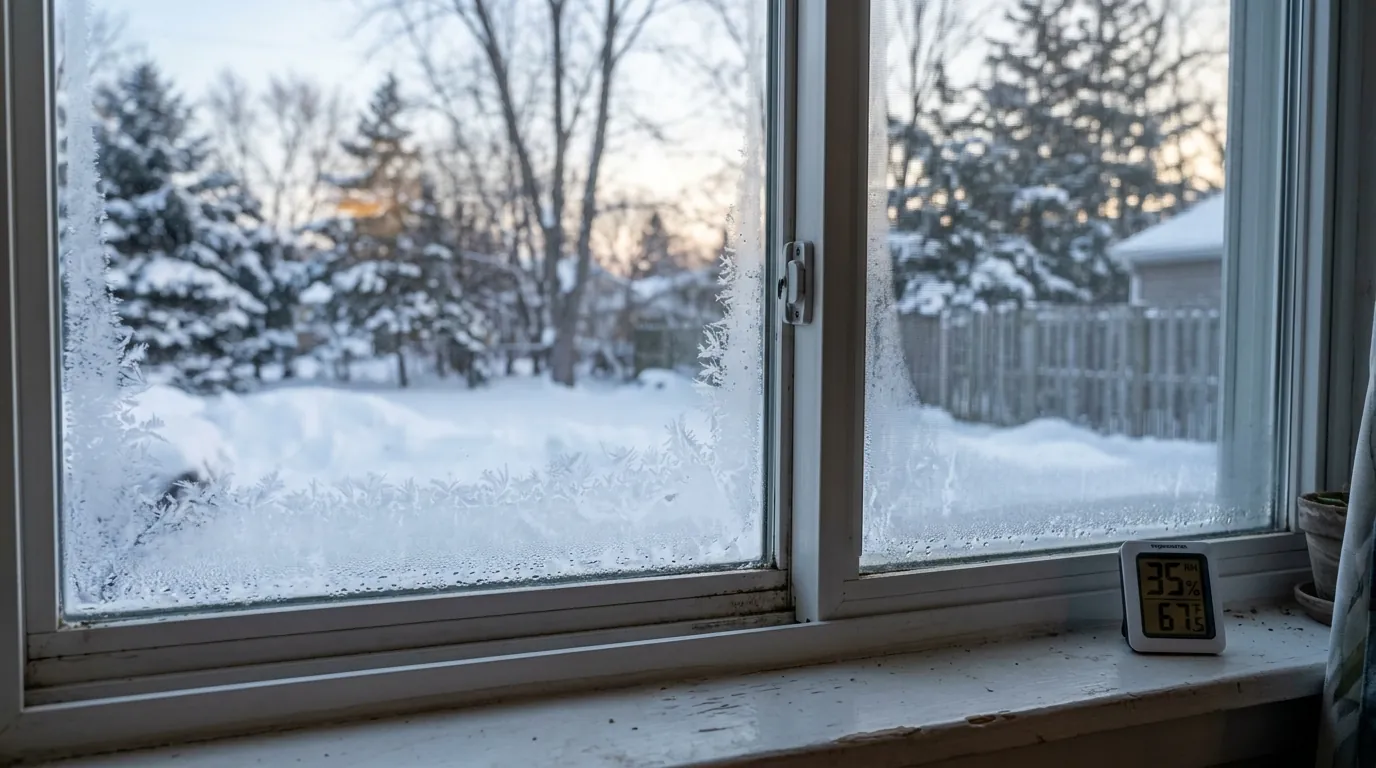
Windows are the first place moisture shows up, because glass is usually the coldest surface in a room. A thin band of fog along the bottom edge of the glass on a very cold morning is common and usually clears as the day warms. That is a sign you are close to the upper limit for that temperature. Watch the sills for the first few cold snaps after you change any setting, since that is when problems show up.
Water running down the glass, puddles on the sill, or frost building on the inside of the window means the humidity is too high for the outdoor conditions. Lower the setting, open blinds and curtains so warm room air can reach the glass, and make sure registers under windows are not blocked. Left alone, standing water on sills leads to peeling paint, swollen wood and mold in the corners of the frame.
If one window always fogs while others in the house stay clear, that window may have a failed seal or a poor storm window, or the room may lack heat. A ceiling fan on low in reverse can also help move warm air down onto cold glass. Closets on outside walls deserve a look too. Leave the doors cracked open in the coldest weeks, and pull stored boxes a few inches away from the exterior wall so air can reach it.
Other moisture sources to watch
A humidifier is not the only thing adding water to the air. Cooking, showers, laundry, houseplants, aquariums and even breathing add a surprising amount, especially in a full house. Before you add a humidifier, measure for a week. Some tighter newer homes already sit near 40 percent in winter with no help at all.
Bathroom and kitchen exhaust fans matter more than most people think. Run the bathroom fan during showers and for 20 minutes after. Make sure the fan actually vents outdoors, not into the attic, where the moisture can frost on the roof sheathing and drip back down when the weather warms. Crawlspaces with bare dirt floors can also feed moisture into the house, and a vapor barrier over the soil helps.
Unvented gas appliances, a blocked dryer vent or a damp basement can push humidity up as well. A dryer vent cleaning is worth doing if laundry days fog the windows. If you notice heavy condensation along with headaches or a stale smell near any gas appliance, leave the house and call 911 or Consumers Energy, since poor venting can also mean carbon monoxide.
Portable units versus a whole-home humidifier
Portable humidifiers work for a single bedroom, but they need daily refilling and frequent cleaning to keep bacteria and mineral scale from building up in the tank. Ultrasonic models can also leave a fine white dust on furniture when filled with hard tap water, which is common in Southwest Michigan. They also tend to run only in the room where they sit, which leaves the rest of the house dry.
A whole-home humidifier mounts on the furnace ductwork and adds water to heated air as it leaves the furnace. Bypass and fan-powered evaporative models use a replaceable water panel, while steam units boil water and work well in larger or tighter homes. The humidifier usually ties into a cold water line and a drain, and it switches on only when the furnace runs, so it does not add moisture while the house is idle. Plan on a new water panel once each heating season, and a quick check of the drain line in the fall. Installed prices in our area commonly run about $587 to $1,240 for an evaporative model, set after the technician sees the furnace and plumbing access.
Turn the humidifier off at the end of the heating season and close the bypass damper if your model has one. Michigan summers are humid on their own, and you do not want the humidifier running with the air conditioner. For help choosing a setup, call (269) 360-5258, any hour.
Lyman Tibbetts, Comfort Guides Editor at Teed Heating & Cooling. Lyman edits the Comfort Guides with our technicians, turning the questions homeowners ask on service calls into plain answers.