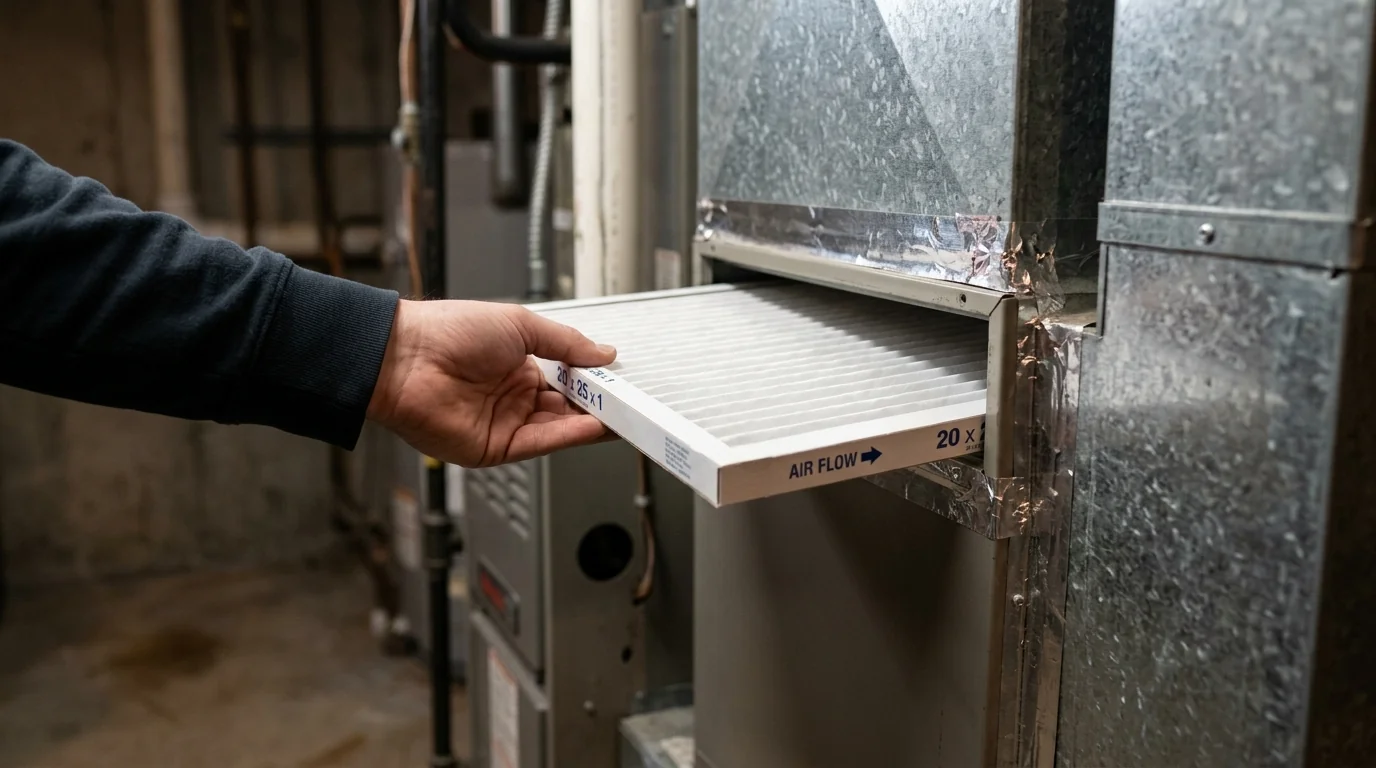
What a furnace filter is really for
The filter in your return air path was first meant to protect the equipment. It keeps dust, lint and pet hair from coating the blower wheel, the evaporator coil above the furnace and the inside of the heat exchanger cabinet. A coil that stays clean moves heat better, and a blower wheel that stays clean moves more air.
Cleaner air in the house is the second benefit. A better filter can catch finer particles such as pollen, mold spores, pet dander and some smoke. How much that helps depends on how often the blower runs, since air only gets filtered while it passes through the system. In a Michigan winter, when the house stays closed up for months, that steady filtering of recirculated air makes a noticeable difference in dust on furniture.
Both goals depend on air actually moving through the filter. A filter so dense or so dirty that it chokes the furnace does not protect anything. It forces the blower to work harder, raises the temperature in the heat exchanger and can cause the furnace to shut itself down on a safety limit.
MERV numbers in plain language
MERV stands for Minimum Efficiency Reporting Value. It is a scale that runs from 1 to 16 for residential and light commercial filters, based on how well a filter catches particles of different sizes in a lab test. Higher numbers catch smaller particles, but they also tend to resist airflow more, especially in a thin filter. Think of MERV as a measure of what the filter catches, not a measure of how well it suits your furnace.
For a typical family home with no special health needs, a MERV 8 pleated filter in a 1 inch slot, or a MERV 11 in a media cabinet, gives a good balance of capture and airflow. Households with allergies or asthma often step up to MERV 11 to 13 in a media cabinet, paired with a check of how the blower responds.
Store brands sometimes use their own scales instead of MERV, so compare the MERV equivalent printed on the package or the manufacturer's website. For most homes, the useful range looks like this:
- MERV 1 to 4: thin fiberglass panels that stop large debris and little else.
- MERV 5 to 8: pleated filters that catch most household dust, lint and pollen. A solid choice for most furnaces.
- MERV 9 to 12: finer pleated filters that catch more dander, fine dust and some mold spores.
- MERV 13 to 16: high capture of fine particles. Best in a thicker media cabinet, not a 1 inch slot.
Why thickness matters as much as MERV
A 1 inch filter has very little surface area. When you push a high MERV number into that thin space, the pleats are packed tight, and the filter resists airflow from day one. As it loads with dust, the resistance climbs quickly. Many furnaces in older Kalamazoo homes have undersized return ducts already, and a dense 1 inch filter makes that worse.
Media cabinets hold a filter 4 or 5 inches deep. Because the pleats are deeper and spread across far more material, the same MERV number causes much less resistance, and the filter lasts much longer before it loads up. That is why a MERV 11 or 13 media filter often moves air more easily than a MERV 11 in a 1 inch slot, even though the MERV number is the same.
If you want better filtration and your furnace has a 1 inch slot, adding a media cabinet in the return is usually a better path than buying the densest 1 inch filter on the shelf. A technician can measure static pressure before and after to make sure the blower is not straining. Your technician can usually add one in a single visit with only minor changes to the return duct near the furnace.
How often to change your filter
There is no single schedule that fits every house. The printed interval on a package assumes average conditions. Pets, construction dust, a household with smokers, nearby farm fields at harvest, or a blower that runs constantly will all shorten it. Check the filter in your own home, and let what you see set your schedule.
Fall and spring are good times to check even if the date says you have time left. Cottonwood fluff in early summer and dust from closed-up winter months both load filters faster than usual.
As a starting point, most homes do well with the timing below. Write the date on the filter frame when you install it, and pull it out to look in good light. A filter that looks gray and matted, or that you cannot see light through, is ready to change. Keep a spare or two of the correct size on hand, since stores often run low during the first cold weeks of fall.
- 1 inch pleated filter: check monthly, change every 1 to 3 months.
- 2 inch pleated filter: change every 3 to 4 months.
- 4 or 5 inch media filter: change every 6 to 12 months.
- Homes with pets, allergies or remodeling dust: check more often in each case.
Airflow tradeoffs and warning signs
Too much filter can cause problems you might not connect to the filter at all. In winter, a choked furnace can overheat and trip its high limit switch, which leads to short cycling and cold air from the vents. In summer, low airflow lets the evaporator coil get too cold and freeze into a block of ice, and the air conditioner stops cooling.
Watch for these signs after switching to a higher MERV filter: louder whistling at the return grille, weaker airflow at far registers, rooms that heat or cool unevenly, a filter that bows or pulls loose from its frame, and higher electric bills from a blower working harder. Variable-speed blowers will push harder against a restrictive filter, which uses more electricity. A dirty filter of any MERV level can cause the same symptoms, so always rule that out first.
If you see those signs, step back down one MERV level or move to a media cabinet. Our technicians can measure static pressure during an airflow and room balancing visit and tell you exactly how much filter your system can handle.
Getting the fit and direction right
A filter that does not fit snugly lets air sneak around the edges, which means dirt bypasses the filter completely and coats the coil and blower. Measure the slot, not just the old filter, and buy the actual size. Nominal sizes on the package are often rounded, so a filter labeled 16 by 25 by 1 may measure a little smaller.
Every filter has an airflow arrow printed on the frame. It should point toward the furnace, in the direction the air travels. Installed backward, some filters load faster and can pull apart. If your filter slot has no cover, a simple cover reduces air leaks and keeps dust from being drawn in around the gap. Return grille filters in a wall or ceiling follow the same rules, with the arrow pointing into the duct.
Filters also help only if the system is otherwise sound. Leaky return ducts in a basement or crawlspace can pull unfiltered air in past the filter. If your home stays dusty even with good filters, a technician can check the returns and, if needed, recommend an air purifier or UV light or a media cabinet upgrade. For questions, call (269) 360-5258 any hour.
Lyman Tibbetts, Comfort Guides Editor at Teed Heating & Cooling. Lyman edits the Comfort Guides with our technicians, turning the questions homeowners ask on service calls into plain answers.