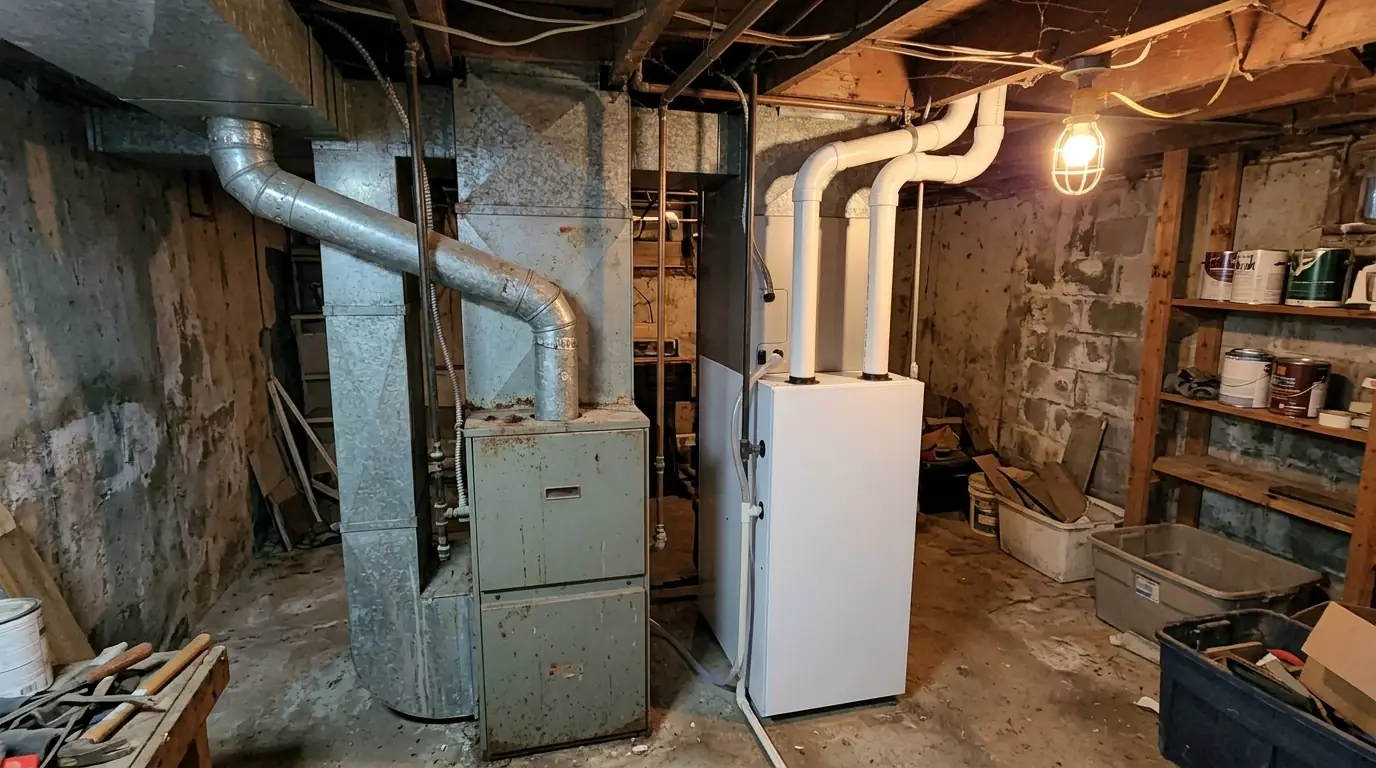
A realistic lifespan for a Michigan furnace
A gas furnace that was sized correctly, installed with good venting and serviced most years will commonly run 15 to 22 years in Southwest Michigan. Some last longer, and plenty of older mid-efficiency units in Kalamazoo basements are still running at 25 or more. Others give out at 12 because of a bad start or years without any care.
The number on its own does not tell you much. A furnace in a tight, well-insulated house with clean ducts may see fewer hard starts than one heating a drafty older home with a heat load it was never sized for. What matters more is how the furnace has been treated and how it is behaving now. Two furnaces of the same brand and age can be in very different shape, which is why a hands-on inspection beats any chart.
Heat exchangers are usually the deciding part. Motors, igniters and control boards can be replaced, but when the heat exchanger cracks or rusts through on an older unit, replacing the whole furnace generally makes more sense than the repair.
Why Michigan winters wear furnaces faster
Kalamazoo heating seasons often run from October well into April, with lake-effect snow bands and nights that drop below zero. A furnace here can log far more run hours per year than the same model in a southern state. Every hour of run time adds wear to the blower motor bearings, the inducer motor and the igniter.
Cycling adds its own stress. Each time the burners light, the heat exchanger expands with heat and contracts as it cools. Thousands of those cycles every winter slowly fatigue the metal, especially around seams and bends. A furnace that short cycles because it is oversized or starved for air goes through far more of those swings than it should.
Basement humidity is the quiet factor. Many Michigan basements stay damp in summer, and moisture combined with flue gases can rust burners, heat exchangers and vent connectors. High-efficiency furnaces also make condensate, and a drain that leaks inside the cabinet can corrode parts from the bottom up.
Habits that add years to a furnace
Most of what extends furnace life is simple. Airflow is the big one. A furnace that moves the right amount of air through a clean filter runs cooler, which keeps the heat exchanger and limit switch inside their normal range.
Annual service is the second lever. A technician cleans the burners and flame sensor, checks the inducer and blower, tests the safety switches and measures combustion. Small problems such as a weak capacitor or a partly blocked drain get caught in October instead of on the coldest night of January. An HVAC maintenance plan puts that visit on the calendar each year so it does not slip.
Run time and short cycles are the other two levers. A furnace that runs long, steady cycles at a sensible thermostat setting wears more slowly than one that is cranked up and down several times a day. Large overnight setbacks in deep cold can force a long recovery run every morning, so a modest setback of a few degrees is usually kinder to the equipment. Here are the habits that make the most difference over the life of a furnace:
- Check the filter monthly in winter and change it when it looks gray or loaded.
- Keep supply registers and return grilles open and clear of furniture.
- Have the furnace cleaned and tested each fall, before the first hard cold.
- Keep the area around the furnace dry, and do not store boxes, paint or cleaning chemicals against the cabinet.
- Clear snow from high-efficiency vent pipes after every storm.
Signs your furnace is near the end
No single symptom means you must replace a furnace, but a cluster of them usually tells the story. Rising gas bills with no change in your habits suggest the furnace is losing efficiency. Rooms that never quite reach the set temperature, or a house that feels warm and then cold again, suggest the system is struggling to keep up.
Repairs are the other clue. When you have paid for an inducer motor one winter and a control board the next, and now the blower motor is failing, the money is adding up on equipment that will keep needing parts. Noises such as rattling, booming at ignition, or a high-pitched squeal also become more common with age. Parts availability matters as well, since some older models use boards and motors that are now hard to find and slow to arrive.
Some signs call for more urgency. Soot around the furnace, a yellow burner flame, rust flakes on the burners, or a carbon monoxide alarm that sounds even once should be taken seriously. If a CO alarm goes off, leave the house and call 911 or Consumers Energy from outside before anything else. A heat exchanger inspection will show whether the furnace is still safe to run. Our technicians will tell you plainly what they find.
Repair or replace: a fair way to decide
A useful rule of thumb multiplies the age of the furnace by the cost of the repair. If the result is above about $5,000, replacement is worth a serious look. A $650 repair on an 18-year-old furnace lands at $11,700, which suggests putting that money toward a new system. A $240 igniter on an 8-year-old unit is an easy repair.
Efficiency can tip the balance. An older 80 percent furnace sends about a fifth of the heat in the gas up the chimney. Modern condensing furnaces rated at 95 percent or higher keep much more of it, which matters in a Michigan winter with a long run season. Your savings depend on gas prices, the size of the house and how much it leaks heat.
Think about the air conditioner too. If the AC is close in age, replacing both at once can mean one disruption, matched equipment and a single visit to set up airflow. Our furnace and AC replacement estimates cover both options so you can compare them.
What to expect when it is time to replace
A proper replacement starts with a heat load calculation, not with matching the size of the old furnace. Many older Kalamazoo homes have had new windows, insulation or an addition since the original furnace went in, and the right size today may be smaller than what is in the basement. Oversized furnaces short cycle and wear out faster. Expect the technician to ask how the house feels in each room, because that tells them where the old system fell short.
The technician will also look at the ductwork, the return air path, the gas line, the venting and the condensate drain route. Switching from an 80 percent furnace that vents into a chimney to a condensing furnace means new plastic venting to an outside wall or the roof, and the old chimney may need a liner if a water heater still uses it. Typical installed prices in Southwest Michigan run about $3,890 to $7,460 for a standard gas furnace, with the final number set after the technician sees the home.
There is no charge for the visit to price a replacement. Call (269) 360-5258 any day, and our technicians will walk through the house, measure what needs measuring and explain your furnace installation options in plain terms.
Lyman Tibbetts, Comfort Guides Editor at Teed Heating & Cooling. Lyman edits the Comfort Guides with our technicians, turning the questions homeowners ask on service calls into plain answers.